EN
EN


Infrared vs Blue Flame Gas Room Heaters: Which Should You Stock?
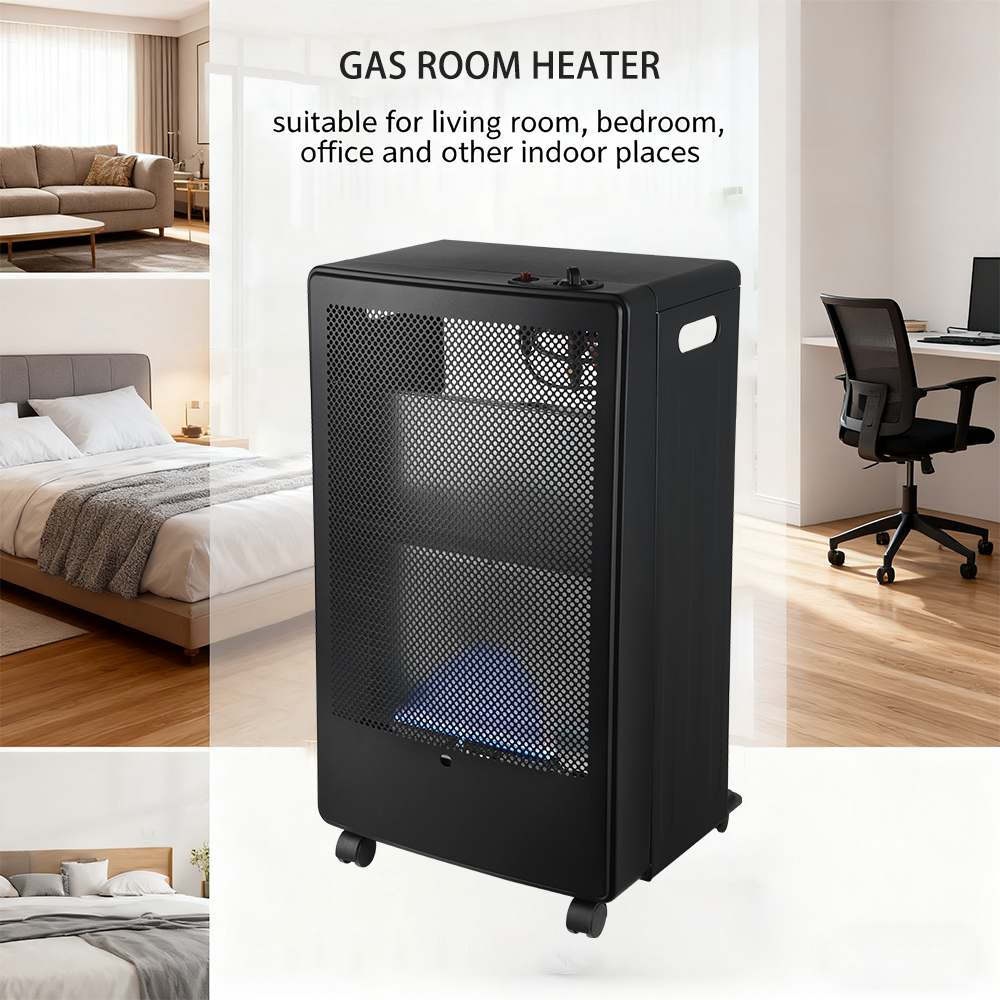
Ask several factories for an indoor gas room heater and you will be offered two kinds of burner without being told which is which. In a catalogue photo a blue flame unit and a ceramic infrared unit look almost identical: the same black cabinet, the same control on top, the same castors at the base.
The difference sits behind the protective grille — and it decides which customers the product suits, how it feels in a room, and whether your container arrives as the product your buyers actually ordered.
At Luoqi both options are built on one chassis. The H002L runs a stainless steel burner and burns with a blue flame at 3.8kW. The H002F runs a ceramic burner and works by infrared radiation at 4.2kW. Everything else — cabinet, controls, safety devices and bottle compartment — is shared. This guide explains what changes between them, and how to choose for your market.
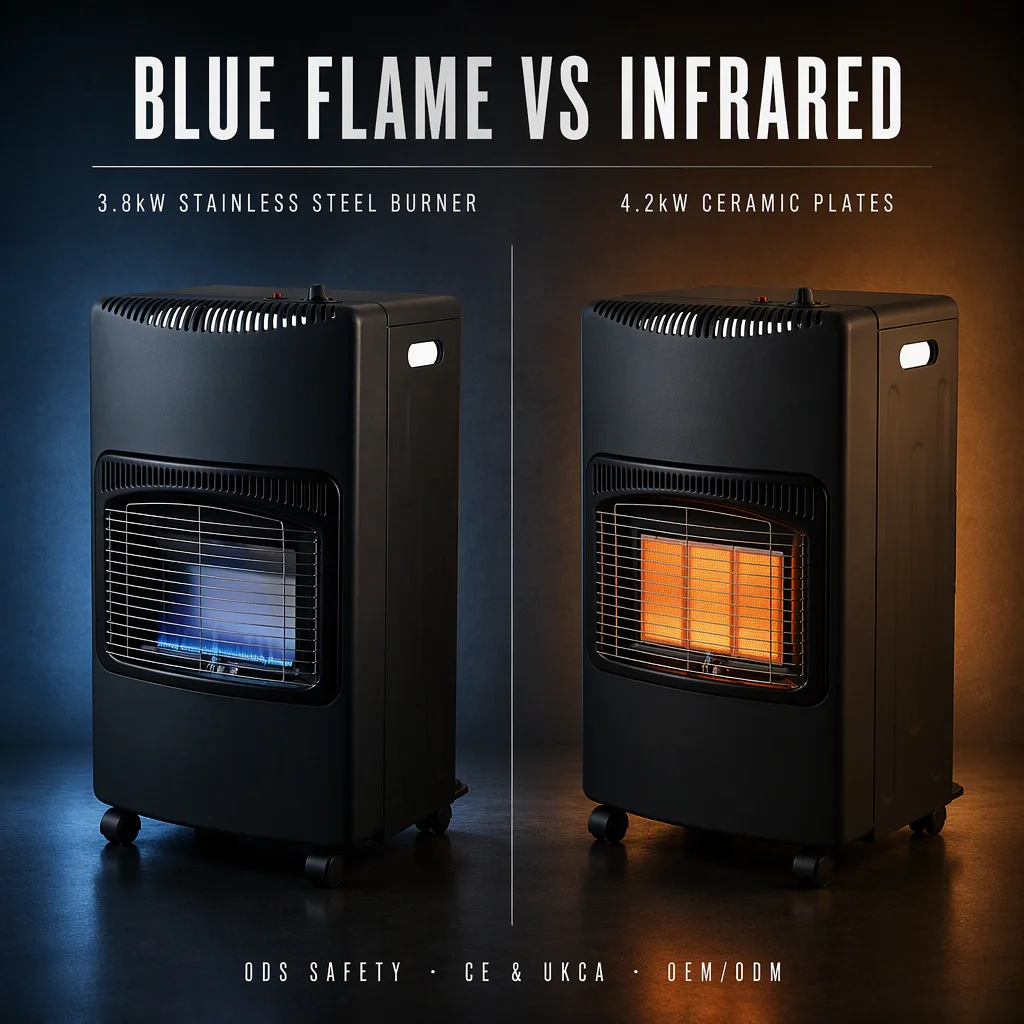
Same cabinet, two burners — H002L blue flame on the left, H002F ceramic infrared on the right
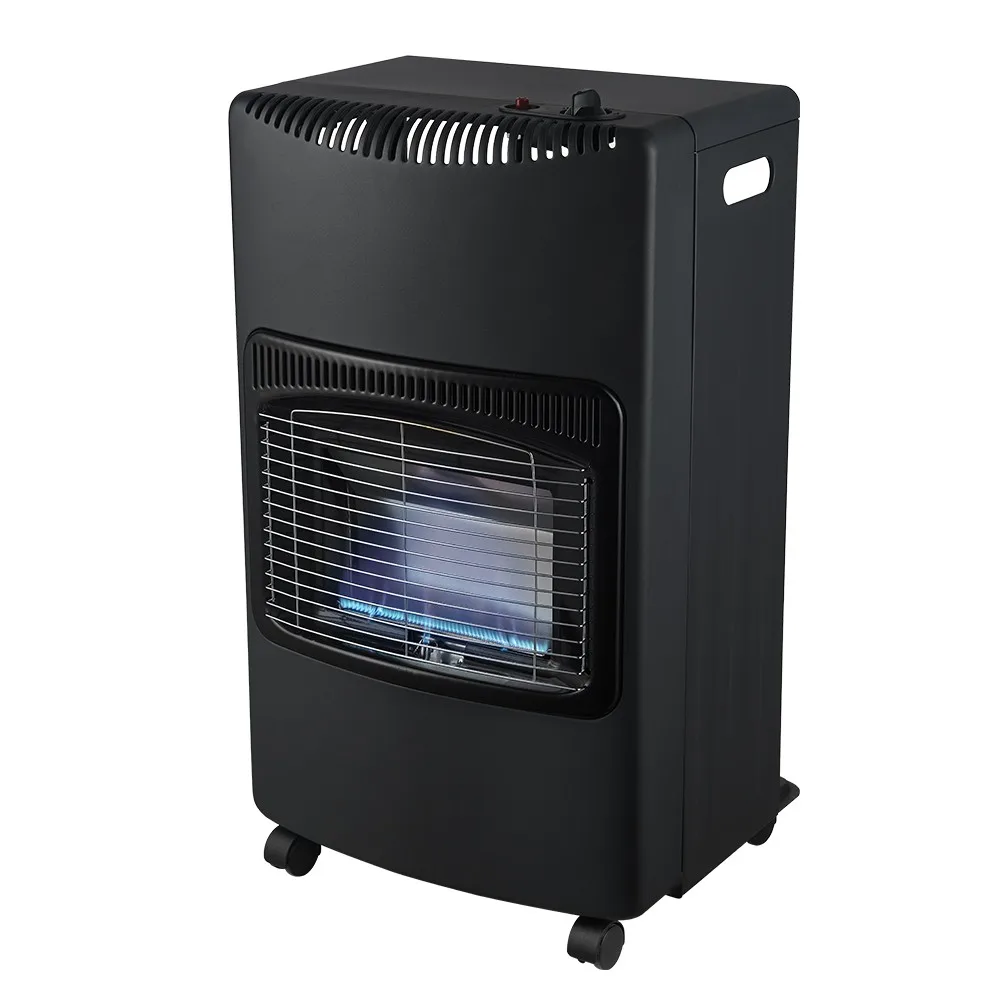
H002L — stainless steel burner, blue flame, 3.8kW
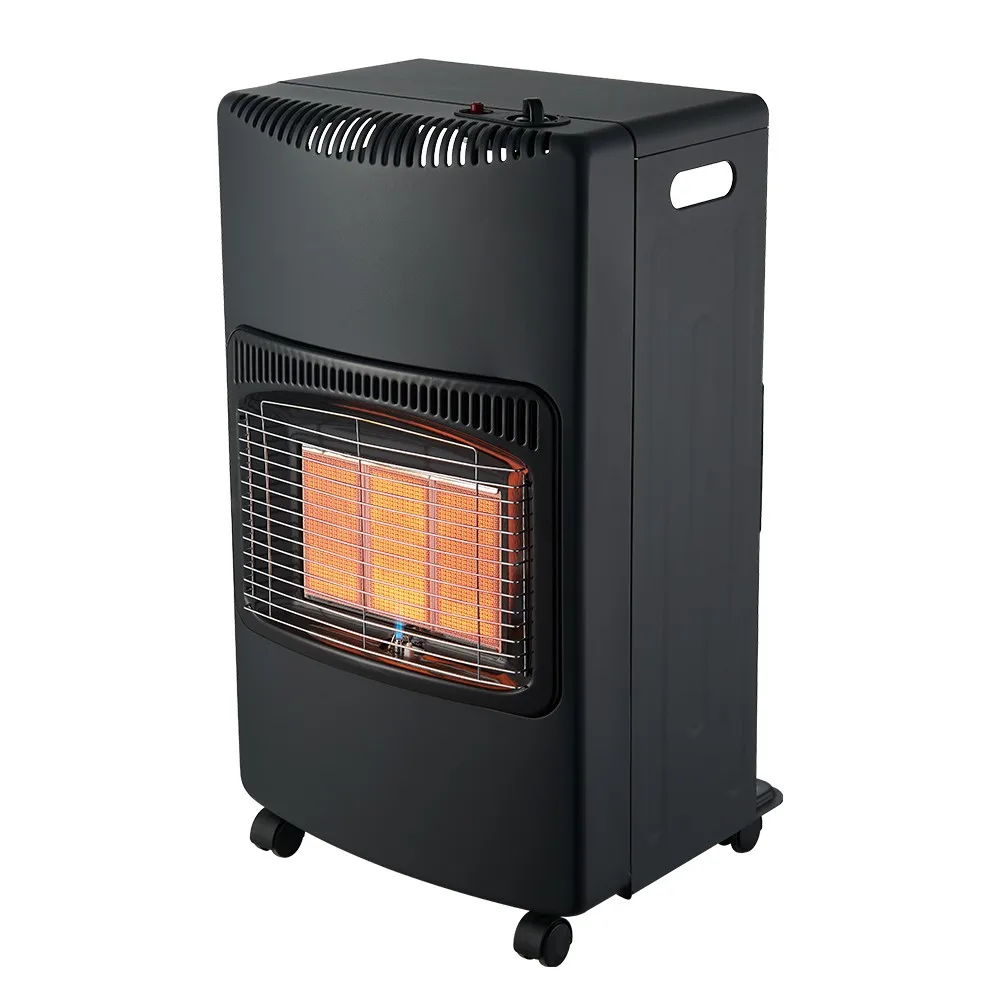
H002F — ceramic burner, infrared, 4.2kW
Same Chassis, Two Burners: What Actually Changes
Luoqi builds the H002L and the H002F on the same body. From the outside you see the same matte black cabinet, the same top-mounted control, the same carry handles and the same four castors. What changes is the burner, the rated output and the flame you see through the grille.
The H002L: stainless steel burner, blue flame, 3.8kW
The H002L uses a stainless steel burner. The gas burns with a clean blue flame, and the heat is released into the air, which then circulates through the room. Stainless steel is specified for the burner because it resists the corrosion that comes from repeated heating and from condensation during storage, and it holds its shape over a long service life — which matters when the unit is expected to run for several seasons.
The H002F: ceramic burner, infrared, 4.2kW
The H002F uses three ceramic plates that glow and radiate. Instead of heating the air first, the plates emit infrared energy that warms people, furniture and surfaces directly. Output is rated at 4.2kW across three power settings, so the unit can be run at part load in a smaller room or at full output in a cold one.
What both models share
Because the chassis is common, the two units share the entire specification outside the burner:
- Piezo-electric ignition — no batteries and no mains power required
- ODS oxygen depletion sensor
- Anti-tilt safety device
- Flame-failure protection
- Four castors for moving between rooms
- Rear compartment sized for a gas bottle up to 15kg (420 × 675mm)
- 0.6mm body panel with a 1.0mm base
- Net and gross weight of 7.5kg / 9kg
For distributors, a shared chassis is worth more than it looks. Two SKUs come from one tooling set and share one spare-parts list, one packaging specification and one instruction set. A mixed container covering both combustion technologies therefore costs less to stock and less to service than two unrelated models would — and it lets a single sales story reach two different customer profiles.
How the Two Technologies Heat a Room Differently
Blue flame: warm air, even temperature
A blue flame burner heats the air. The warm air rises and circulates, so the whole room moves toward a similar temperature. That behaviour suits a living room or an office occupied for hours: the temperature stays even and there is no single hot spot to sit in front of. Combustion quality matters commercially as well — a correctly tuned blue flame produces very little soot or odour, which is what keeps after-sales complaints down in markets where the unit is used daily.
Ceramic infrared: heat you feel immediately
A ceramic plate burner radiates. You feel the warmth within seconds of ignition, before the room air has changed temperature at all. The practical consequence is that infrared copes with conditions that defeat convective heating: draughty rooms, doors that open constantly, high ceilings, and spaces where the air is replaced faster than it can be warmed. It is also the more useful technology for garages, workshops, warehouses and RVs, where heat has to arrive quickly and locally rather than evenly.
Where each one wins
As a working rule: if the room is closed and occupied for hours, blue flame gives the steadier result. If the room is open, draughty, intermittently used, or simply hard to heat, ceramic infrared gives the faster and more targeted result. Buyers who want to cover both use cases should stock both burner types rather than pick one — which is exactly what a shared chassis makes practical.
Which Variant to Stock for Which Market
Regulated markets: Europe and the United Kingdom
The EU and the UK are the markets where paperwork decides the sale. Indoor gas heaters are covered by gas appliance regulation, and buyers supplying retail chains are asked for documentation that names the exact model. Both the H002L and the H002F are built with the same indoor safety package — ODS, flame-failure protection and anti-tilt — which is what those markets look for first. Our range is supplied with CE and UKCA documentation, and certificates are issued per model, so request the certificate that names the model number you are importing rather than a general supplier document.
Markets where the grid is unreliable
Neither variant needs electricity. Both ignite by piezo and run from a cylinder, so in markets with rolling blackouts or heavy seasonal grid strain the product keeps working when electric heating cannot. This is one of the most durable selling arguments in the category, and it applies equally to the blue flame and the infrared model — a point worth making explicit on your own product pages.
Cold, hard-to-heat housing stock
Where housing is poorly insulated, doors open constantly, or winter temperatures drop hard, the radiant model tends to win the repeat order: the customer feels the effect immediately instead of waiting for air temperature to move. Where rooms are better sealed and the heater runs all evening in one place, the blue flame model suits better. If you are unsure which profile dominates your market, order both burners in the first container and let your own sell-through answer the question.
What to Verify Before You Order
Both models look the same on a shelf, which is precisely why the specification has to be confirmed in writing rather than inferred from a photograph or a product title.
- Burner type on the purchase order. State "stainless steel blue flame" or "ceramic infrared" explicitly — not "gas room heater".
- Rated output. 3.8kW on the H002L, 4.2kW on the H002F. Confirm the nameplate matches the figure printed in your own listing.
- Gas configuration. Supply pressure, injector size and cylinder connection standard differ by country, and a unit tuned for one market's LPG can be inefficient or unsafe on another's.
- Safety package. Confirm ODS, anti-tilt and flame-failure protection on the model you are ordering, and check that the instruction booklet describes the same devices.
- Bottle compartment. The rear compartment accepts a bottle up to 15kg (420 × 675mm). Check that the standard cylinder in your market fits before committing to volume.
- Certification per model number. Ask for the certificate that names your exact model, and confirm the label language and pressure setting match your market.
- A burning-unit photo before container volume. Order one sample and ask for a photograph of it running. It is the fastest way to prove which burner you are actually buying.
The risk buyers underestimate: a mislabeled burner type
Because the two units share a cabinet, a catalogue or web page carrying the wrong burner description is easy to produce and expensive to discover. An infrared heater listed as blue flame — or the reverse — reaches your customer as the wrong product, and the return or claim lands on you rather than on whoever mislabeled it. Verify the burner type from a photograph of the unit burning or from the specification sheet, never from a product title alone. If a supplier cannot show you both, treat the specification as unconfirmed.
Professional Tips for B2B Buyers
- Order both burners in the first container. One chassis, two technologies, one spare-parts pool — the cheapest way to learn which one your market accepts.
- Put the burner type and output on the PO in writing. "Gas room heater" is not a specification.
- Ask for a burning-unit photo and a nameplate photo. Two images resolve the most common sourcing error in this category.
- Confirm the certificate names your model number. A general CE or UKCA document does not cover every model in a catalogue.
- Check the bottle compartment against your local cylinder. A 15kg compartment is a constraint, not a formality.
- Ship the instruction booklet in the destination language. If a misuse claim ever follows, the manual is your first piece of evidence.
FAQ
Q1: What is the difference between the H002L and the H002F?
The burner and the rated output. The H002L uses a stainless steel burner and burns with a blue flame at 3.8kW. The H002F uses three ceramic plates and heats by infrared radiation at 4.2kW. Cabinet, controls, safety devices and bottle compartment are shared.
Q2: Which one heats a room faster?
The H002F feels faster, because infrared warms people and objects directly within seconds of ignition. The H002L takes longer to show an effect because it heats the air first — but it produces a more even temperature across the room once it does.
Q3: Is one cheaper to run?
Neither model needs electricity, so running cost is driven by local gas price and by how the unit is used rather than by the burner technology. The infrared model rewards short, intermittent use in difficult spaces; the blue flame model rewards long, steady sessions in a closed room.
Q4: Do both models have an ODS?
Yes. Both are built on the same indoor safety package: ODS oxygen depletion sensor, anti-tilt device and flame-failure protection.
Q5: Do the heaters need electricity?
No. Ignition is piezo-electric and operation is fully mechanical, so no power outlet is required anywhere in the building.
Q6: What size gas bottle do they take?
The rear compartment accepts a bottle up to 15kg, with a compartment size of 420 × 675mm.
Q7: Can we order both models in one container?
Yes. Mixed containers are routine for this chassis, which is one of its main commercial advantages for distributors.
Q8: Can we order them under our own brand?
OEM and private-label options cover branding, packaging and instruction sets. Send us your target market and we will confirm the configuration that applies.
Conclusion
Infrared and blue flame gas room heaters solve different problems, and buyers who do well in this category usually stock both rather than argue for one. Because the H002L and the H002F share a chassis, cabinet, safety package and spare-parts list, carrying both costs little more than carrying one — and it lets you answer whichever question your market asks first.
Request specifications, a burning-unit photograph, certification documents and volume pricing for the H002L and H002F, or discuss OEM branding for your market, through our inquiry form. You can also review the H002F-1 gas room heater specification or the wider gas room heater range.
Related reading: Gas vs Electric Room Heaters Comparison, Misconceptions About Using Gas Room Heaters, How to Choose a Gas Room Heater Manufacturer