EN


LQ-B01 and LQ-B02 Tabletop Bio-Ethanol Fireplaces: A Sourcing Guide for Importers
A tabletop fireplace is not a small heater. That single distinction decides whether a container of them makes money or sits in a warehouse for a season. The category sells on atmosphere — a real flame in the middle of a table — and it is bought by gift channels, hospitality buyers and home décor retailers far more often than by heating distributors. Price it, certify it and package it as a décor object rather than as an appliance, and the margins hold up.
We build two shapes for that market and they do different jobs. The LQ-B01 is low and wide: a curved body carrying flat glass panels, so the flame sits almost at table level and reads as a pool. The LQ-B02 is tall and enclosed: vertical glass rising from an octagonal base, so the flame reads as a column. Both are decorative alcohol units built for a tabletop, and both are sold on the same promise — a real flame you can put in front of a guest without a chimney, a flue or a gas line.
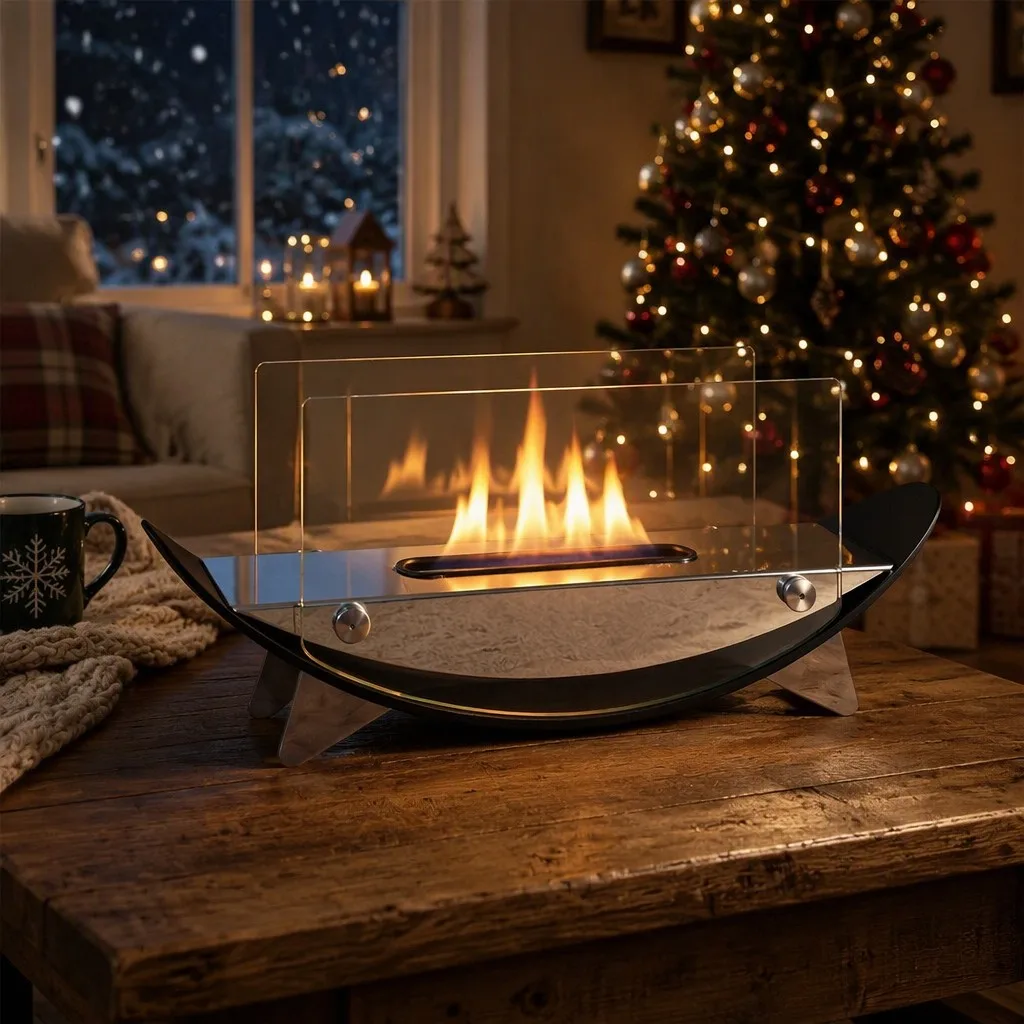
LQ-B01: a wide, low tabletop fireplace, glass panels either side of the flame
Two Formats, Two Different Jobs
LQ-B01 — the centrepiece
A low, curved body is the friendliest shape for a gift box and the easiest to place. It sits at coffee-table height, spreads the flame across a wide burner slot, and the glass panels either side keep the flame from lying flat in a draught. That horizontal spread is what sells it in photographs: the flame fills the width of the tray rather than standing up in a single tongue.
Commercially, this is the gifting SKU. It photographs well, it reads instantly as a present, and it suits seasonal programmes — Christmas, New Year, Valentine’s, housewarming. Bear in mind what that means for your order: the selling window is short, so the carton has to survive a peak-season freight cycle without a second shipment, and the instruction leaflet has to work for a customer who has never lit a liquid-fuel appliance before.
LQ-B02 — the lantern
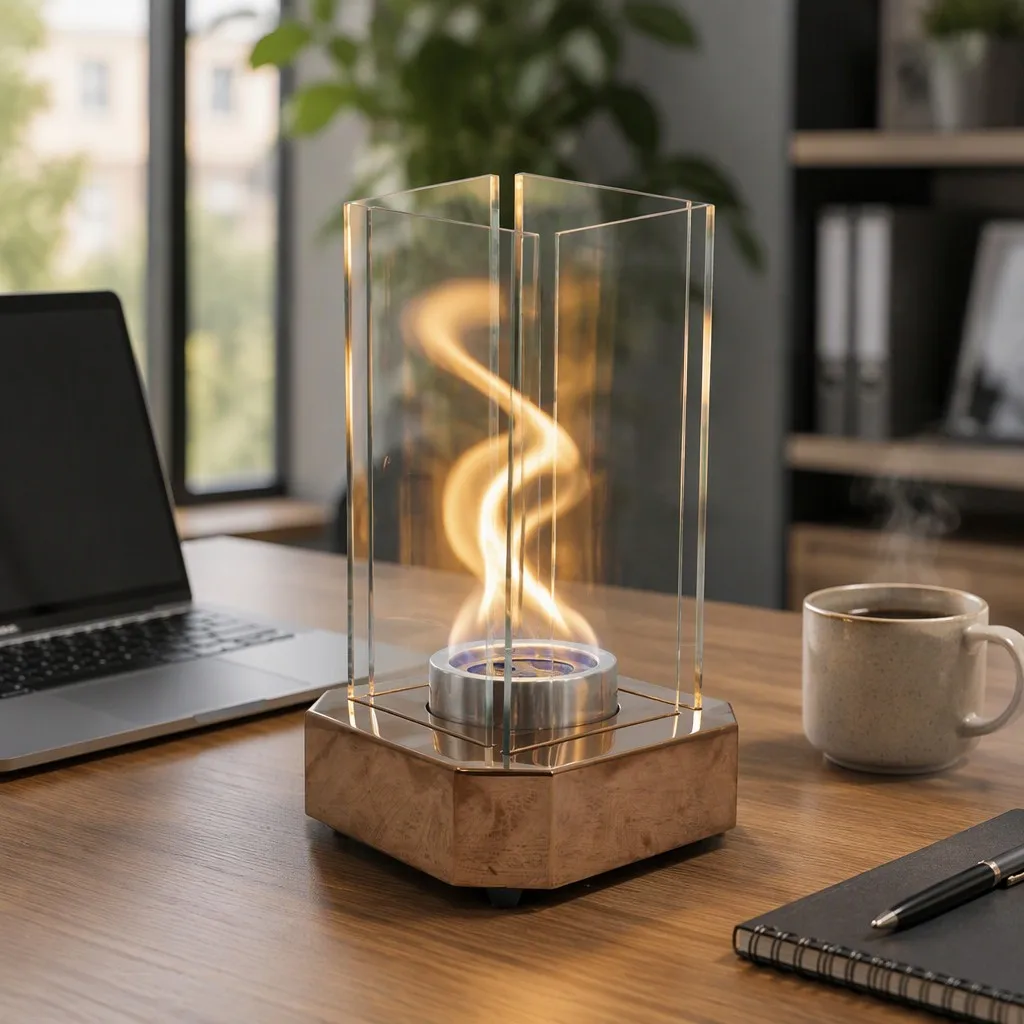
LQ-B02: vertical glass on a weighted octagonal base, so the flame reads as a column
Raising the glass turns the same flame into a vertical object. On an eight-sided base, with glass panels rising on several sides, the unit reads as a lantern or a small sculptural piece, which is why it holds up on a desk, a reception counter, a restaurant table or a hotel suite — places where a wide tray would be in the way. It also stands up better to air movement, because the glass surrounds the flame on more sides.
Commercially, this is the year-round, contract and hospitality SKU. It is less obviously a gift and more obviously a fitting, which makes it the easier sell into hotels, bars and interior projects where the buyer is furnishing a space rather than buying a present.
Which to stock
If you are building a gift programme, lead with the LQ-B01 and treat the LQ-B02 as the step-up line. If you supply hospitality or interior projects, reverse it. Most distributors end up with both, because the two shapes cover the two buying occasions and share a fuel and a warning vocabulary.
The Burner Decides Everything
The steel and the glass are what the customer sees. The burner is what determines the standard you certify against, the burn time you can print, and the service calls you get. Ask for the burner specification before you ask for a price.
Manual or automatic
Both photographs show a manual burner: an open reservoir the user fills and lights. That matters commercially because the European standard family for this product is split along exactly that line — the manual flueless units sit under one part of EN 16647 and the automatically controlled units under another. Confirm which type you are buying, because it changes the test programme and the labelling.
Capacity and burn time
Ask for the reservoir capacity in litres and the burn time at the intended flame height, with the test conditions stated. A burn time quoted without a flame height or a room condition is a number for a catalogue, not for a specification. If you are selling into hospitality, burn time per fill is the specification your buyer will care about most, because refilling a table in a bar is staff time.
Fill level and spill control
A decorative burner should make overfilling difficult rather than merely warn against it. Ask how the fill level is indicated, whether the reservoir can overflow when it is filled warm, and what catches a spill. This is the single most common cause of the accident these products are known for, and it is a design question, not a user-error question.
Extinguishing
Ask what the unit ships with to put the flame out — a snuffer, a damper or a lid — and whether it is supplied with the unit or sold as an accessory. A burner that can only be left to burn out is a burner that will be blown out by a customer, and that is when the flame lands somewhere it should not.
Glass, Stability and Heat Clearance
Glass is the product, and the risk
On a decorative fireplace the glass is doing two jobs at once: it is the wind guard that keeps the flame vertical, and it is most of what the customer is paying for. That makes it the number one breakage claim in the category. Ask what kind of glass is specified, how the edges are treated, and how the panel is mounted — a panel held on standoffs at two points behaves very differently under a knock from one held along its full edge.
Ask for the replacement panel as a stocked part. A glass fireplace with no spare glass is a unit that gets written off over a chip.
Stability and tipping
The taller the glass, the more the unit behaves like a lever. On the LQ-B02 the glass rises well above the base, so the base weight is the safety feature, not a styling choice. Ask what the base weighs, whether it has a non-slip foot, and what happens when someone leans on the glass edge on a soft surface such as a tablecloth or a rug. A unit that tips is a unit that spills burning fuel, which is the scenario the whole design has to avoid.
On the LQ-B01 the risk runs the other way: it is low and stable, but wide, so it needs a clear footprint either side. Confirm the footprint against the standard table sizes in your market before you print a retail listing.
Clearances
A tabletop fireplace is usually placed under something — a shelf, a wall unit, a picture, a curtain, a Christmas tree. Ask the factory for the clearance guidance they expect you to publish, and check it against the way your market actually furnishes a room. The glass and the metal both get hot, and a customer who moves the unit while it is burning is the normal case, not the exception. The instruction sheet has to say so plainly, in the language of the market you are shipping to.
Compliance: What to Certify Against
This is the step where first-time buyers in the category get caught, because a certificate from a gas appliance is not transferable. A decorative alcohol fireplace is certified as what it is.
Europe and the UK
The reference in Europe is the EN 16647 family, which covers decorative fireplaces producing a flame from alcohol-based fuel in domestic use. The family is now split: EN 16647-1 covers alcohol-powered flueless fireplaces, and EN 16647-2 covers the automatically controlled type. Which part applies to you follows directly from the burner question above. For the UK, the same technical content is applied through the UKCA route — confirm with your test house which edition they will test to, because the parts have been revised recently.
North America
The North American reference is UL 1370, which covers alcohol fuel-burning fireplace units. Do not assume that a European report satisfies a North American buyer, or the reverse. If you sell into both, budget two programmes rather than one.
Labelling and warnings
The standard is not only about the hardware. Ventless alcohol appliances carry labelling and warning requirements, and in some European markets the authorities have taken a close interest in how those warnings are presented at retail. Treat the warning set as a deliverable you specify — language, size, placement on the carton and on the unit — rather than something the factory adds at the end. Ask for the artwork files with the quotation.
Fuel and Packaging
Ship dry
Ethanol fuel is a flammable liquid and is regulated as dangerous goods in transport. Do not co-load fuel with the units, and do not let a supplier talk you into a “sample with fuel” — it changes the shipment class and the paperwork. Ship the appliance dry, and let the buyer source fuel in their own market.
Fuel quality is your specification too
Your customer will burn whatever is sold locally, so the burner has to be specified against the fuel grades available in the destination market, not against a laboratory grade. Ask the factory what fuel specification the burner was designed for, and put it in the manual. If the unit is sold where gel fuel is common, be explicit about whether gel is acceptable — a liquid burner presented as dual-fuel without the engineering behind it is a liability, not a selling point.
Packaging is where the margin leaks
Glass plus a weighted metal base is an awkward carton. Everything that can go wrong in this category goes wrong in transit: a chipped glass edge, a bent standoff, a base that shifts and cracks a panel. Ask for the drop-test report, the inner protection (moulded pulp, EVA or foam), whether each unit ships in its own retail carton, and the master carton count. Then ask what the factory does when a panel arrives broken, because your returns policy is built on that answer.
OEM, MOQ and the Gift-Channel Angle
A decorative fireplace is an easy product to brand and a hard product to re-engineer, which makes it a good OEM candidate. The variables that actually move the needle are the finish on the metal, the glass configuration, the retail carton and the manual — not the burner. Bring those four to a factory and you have a programme; bring a request for a new burner and you have a development project.
Ask for finish options across the body — brushed steel, matte black, warm brass tones — because in this category the finish is the difference between a gift-shop SKU and a hotel fitting. Ask for a colour box and a manual in your market’s language, and ask what the minimum quantity is when the carton and the manual change but the hardware does not. That number is usually far below the number for a new tooling.
Professional Tips for Buyers
- Buy this as décor, not as heating. The heat output is small and the customer is buying a flame, not a radiator.
- Ask for the burner type first. Manual or automatic decides your entire certification route.
- Never accept a burn-time figure without the flame height and test condition that produced it.
- Specify the glass as a stocked spare part on the first order. It is the part that breaks.
- Ship dry, always. Fuel is a dangerous good and it is not your product.
- Get the warning and label artwork with the quotation, in every language you sell in.
- Ask for the drop-test report and a sample carton, not just a specification sheet.
- Check base weight against glass height on the tall unit before you commit to a hotel project.
FAQ
What are the LQ-B01 and LQ-B02?
Two tabletop decorative fireplaces that burn alcohol-based fuel. The LQ-B01 is a low, wide unit with a curved body and glass panels; the LQ-B02 is a taller unit with vertical glass rising from an octagonal base. Both are designed to sit on a table, not to heat a room.
What fuel do they burn?
Alcohol-based liquid fuel of the type sold for decorative fireplaces. The exact fuel specification the burner was designed for should be stated in the manual and confirmed with the factory for your market, because fuel grades differ between countries.
Do they need a chimney or a flue?
No. They are flueless decorative appliances, which is why the installation is simply “put it on a stable surface”. It is also why the ventilation guidance and the warning set matter more than they would on a vented product.
How long does one fill last?
It depends on the reservoir capacity and the flame height. Ask for both figures together, with the test condition, for each model — a burn time quoted on its own is not a specification you can print.
Is the glass tempered?
Confirm the glass specification with the factory for the model you are ordering, and ask how the panel edges are treated. Whatever is specified, order spare panels with the first shipment.
Which standard applies in Europe and in North America?
In Europe, the EN 16647 family — EN 16647-1 for alcohol-powered flueless fireplaces and EN 16647-2 for automatically controlled units. In North America, UL 1370 for alcohol fuel-burning fireplace units. A gas appliance certificate does not carry across.
Can the units ship with fuel?
No. Ship the appliance dry and let the buyer source fuel locally. Fuel is a flammable liquid regulated as dangerous goods, and co-loading it changes the shipment class.
Can we order under our own brand?
Yes. Finish, glass configuration, retail carton and manual are the practical customisation points, with a lower minimum quantity than a hardware change would require.
Next Step
If you are adding a decorative flame line to a gift, hospitality or décor programme, tell us which occasion you are buying for — a seasonal gift window or a contract fit-out — and we will point you at the right shape rather than the whole range.
Send the destination market, the volumes you expect and the retail channel, and Zhongshan Luoqi Appliance will come back with the burner specification, the certification route that applies to your market, the carton data and a quotation. If you also buy heating appliances, the gas room heater range sits alongside this line.