EN
EN


Modular Outdoor Kitchen with Built-In Gas Grill: A Sourcing Guide for Importers
For years, outdoor cooking meant one product: a freestanding grill on casters. That is no longer how importers in North America, Australia and Western Europe specify it. The enquiry arriving at factories now asks for a built-in run — a continuous stainless steel cabinet that carries the grill, the sink, the storage and the cooling in one linear unit, sized to a terrace or to a project kitchen zone.
That shift suits a factory that can build it and catches out importers who have never specified it. A freestanding grill is a box. A modular run is a system: the modules have to line up across a two-and-a-half-metre fascia, ship as one length, and still be straight and rust-free ten years into a coastal climate.
This guide covers what is actually being specified in built-in outdoor kitchens, what to verify before you commit a container, and where the risks sit.
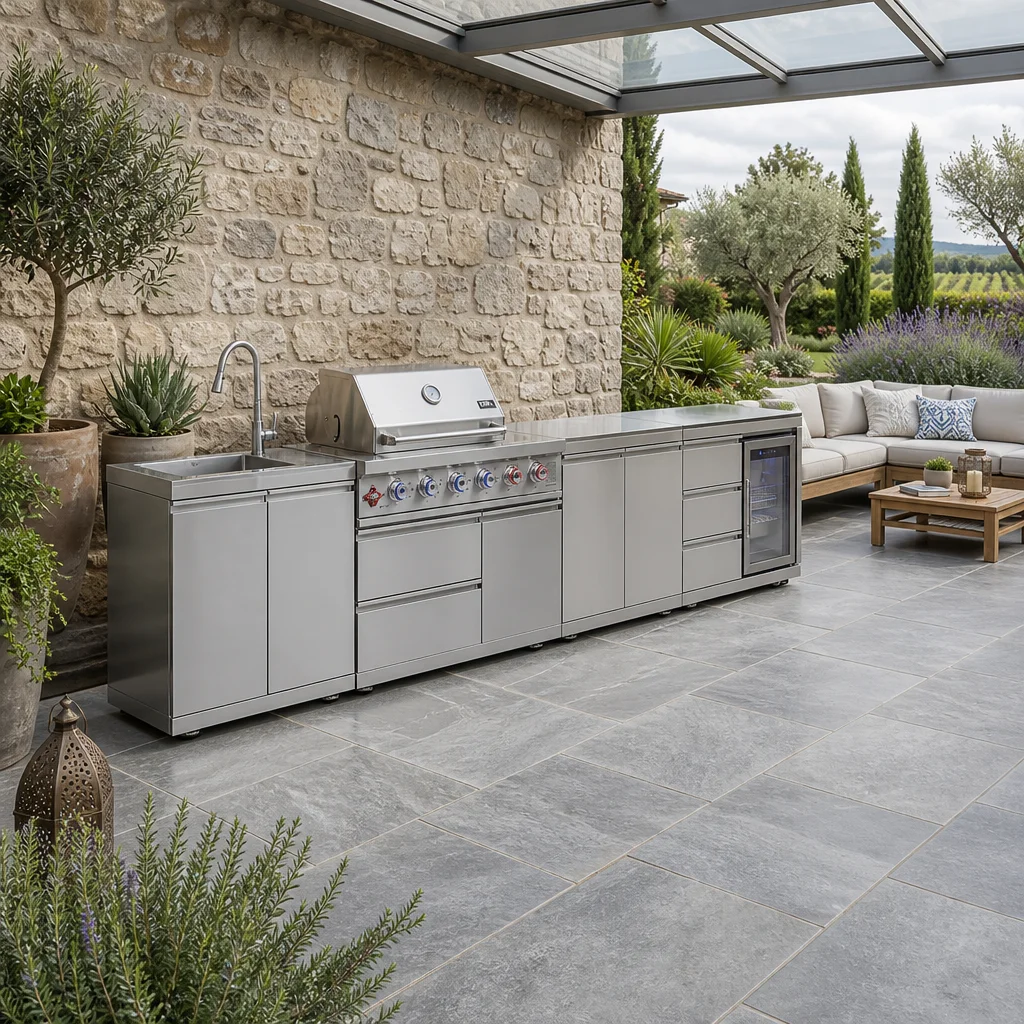
A modular run in service: gas grill, sink, storage drawers and a glass-door cooler on one continuous counter
The Built-In Format, and Why It Is Growing
A modular outdoor kitchen is not a new category. What changed is the demand pattern. Distributors who used to sell one grill are now asked for the whole cooking zone — somewhere to prep, somewhere to wash up, cold storage for drinks and food, and a counter that doubles as a serving surface.
Two practical reasons sit behind it. The purchase is usually tied to a landscaping or construction project — a new terrace, a deck, a pool surround — and a built-in run is easier to sell into that budget than a single appliance. And the four items a customer would otherwise buy separately (grill, cooler, sink, cabinet) land on one order instead of four, which lifts the value of each delivery.
What buyers compare, market by market
In North America the starting point is the grill: output, hood volume, burner count, and whether the unit can be connected to natural gas rather than run from a cylinder. In Australia the first question is usually how the frame behaves in salt air. In the Gulf and in parts of Africa the priorities are heat and dust — whether coated surfaces stay stable under year-round UV, and whether the fronts still align after a summer of expansion. European buyers tend to ask about documentation first and grill output second.
None of that changes the underlying product. It changes which specification you put in front of the buyer first.
How a Modular Run Is Put Together
A run is assembled from modules that share one cabinet depth and one fascia height, so the fronts align across the whole length. Once that geometry is fixed, the modules can be combined in almost any order.
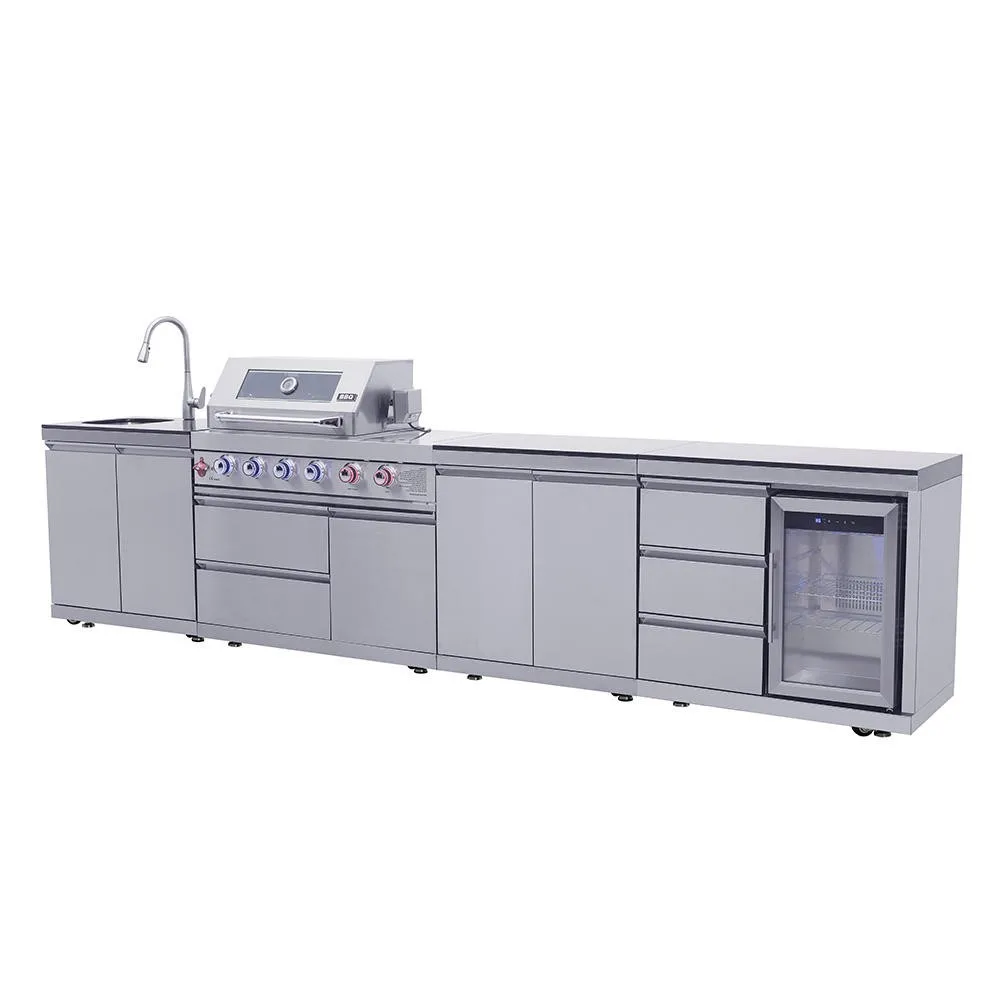
The module order is free: here the sink and the grill sit at one end, with storage and the glass-door cooler along the remainder of the run
The grill module
This is the module your customer will judge the entire unit by. Raise the points that matter commercially: whether the hood closes smoothly on one hand, the internal volume, how the burner controls are laid out, and whether the unit is supplied for LPG, for natural gas, or for either. Ask for the temperature rise behaviour at the hood rather than a peak figure nobody can reproduce in a garden. If your market also buys freestanding units alongside a built-in run, see our BBQ grills.
The cabinet run and countertop
The cabinet is where a low-cost unit gives itself away. Panels specified too thin will drum and ripple once sunlight heats them. Doors that are not braced will twist — and once one door twists, the run never looks straight again. Ask what the panel gauge is, how the carcass is stiffened, and how the countertop is supported along its length and at the joints between modules.
The sink module
An outdoor sink is a drainage problem before it is a plumbing problem. Confirm the drain arrangement, whether the module is designed for a gravity outlet or a pumped waste, and what happens to the underside of the cabinet where water inevitably ends up. A sink module with a sealed, properly pitched floor is worth more than one with an extra door.
Refrigeration and storage modules
A glass-door cooler is the highest-attention, thinnest-margin module in the run. Confirm the voltage and frequency it is built for, whether it uses a compressor or an absorption system, and what its ambient temperature limit is. An appliance rated for an indoor kitchen will struggle on a south-facing terrace in August, and that failure will be blamed on the kitchen, not on the cooler.
Drawers and doors are the opposite case: low attention, high volume, and the parts your dealer will come back for. Ask for the hardware source and confirm that spares can be supplied.
Stainless Steel: What to Specify and What to Verify
Grade and finish
For general outdoor use, 304 stainless is the grade most importers specify. For coastal installations within sight of salt water, 316 is the specification that keeps warranty claims quiet. Finish matters as much as grade: a brushed surface hides handling marks and fingerprints far better than a polished mirror surface, which shows every touch and every water mark.
Frame, panel and weld construction
Corrosion almost never starts in the middle of a panel. It starts at a weld, a cut edge or a fastener — anywhere the protective surface has been disturbed. Ask how welds are treated after finishing, whether all fasteners are stainless, and whether dissimilar metals are isolated where parts meet.
Coastal and high-humidity markets
If you sell into salt air, say so at the quotation stage, not after the first container arrives. The conversation changes: grade, passivation, fastener specification and even packaging all move. It is far cheaper to build for that market at the factory than to defend your product in it afterwards.
What to Lock Down Before a Container Order
Module mix and the length of the run
Fix the total length and the module order in writing. Runs of this type commonly reach around 2.5 metres, which is already at the limit of what two people can handle on site — so agree how the unit is split for transport and how it re-connects. Decide early whether you are buying one rigid assembly or several bolt-together modules, because that single choice drives packaging, freight and installation.
Packaging for long linear units
A long, thin, heavy carton behaves badly inside a container. Ask how the run is crated, whether the countertop is braced against vertical load, and what protects the corners and the door fronts. Request a loading plan that shows units per 40'HQ and where each crate sits. Freight damage on a linear unit is almost always a packaging decision, not an accident.
Documentation, spare parts and after-sales
Agree the document pack for your market before the order: test reports, declarations, and whatever market-specific approval applies to gas appliances where you sell. Then agree the spares list — hinges, drawer runners, knobs, igniters, seals and the cooler control module — and put a first-stock spares order on the same container. A unit that cannot be repaired locally becomes a complaint instead of a repeat order.
OEM and ODM: Where Customisation Pays
Three places worth paying for
Customisation earns its cost in three places: the fascia and finish, so the run matches your brand and your market's aesthetic; the module mix, so a short configuration exists for smaller terraces alongside a long one for projects; and the packaging, so your label, barcode and language are correct the moment the container is opened. Re-tooling the grill itself rarely pays unless your volume justifies it.
What to bring to a factory
Bring six things: a dimensioned sketch of the run, the module list, the target market and its gas type, the local voltage, the finish you want, the packaging requirement, and your annual volume estimate. With those, a factory can quote a real programme instead of a catalogue item.
Site Preparation Questions Your Dealers Will Ask
- What is the footprint, including clearance for the hood to open and for doors and drawers to travel?
- Does the unit need a gas point, a water supply and a waste connection — or only some of them?
- What power does the run need, and is that one socket or one per appliance?
- Is the run freestanding, or must it be fixed to a wall or a plinth?
- How is it levelled on an uneven terrace?
- How is the cooler ventilated, and how much rear clearance does it need?
These questions arrive in the first week after a customer sees the product. One page of installation data answers all of them and removes most of the pre-sales back-and-forth.
Professional Tips for Buyers
- Fix the module geometry first. Packaging, freight and installation all follow from the run length and the fascia height.
- Ask for a pre-production sample, or at least a factory-assembled dry build, before tooling or a first batch.
- Put the market's gas type and voltage in the enquiry, not in the order confirmation.
- Buy spares with the first container. The parts that fail are predictable: hinges, runners, igniters, seals.
- Treat packaging as a specification line, not as a cost to be squeezed.
- Reconcile the factory's loading plan against your own freight forwarder's figures before you book.
- Keep one document pack per market and reuse it for every shipment to that market.
Frequently Asked Questions
What is a modular outdoor kitchen?
It is a built-in outdoor cooking unit assembled from modules — grill, sink, storage and refrigeration — that share the same cabinet depth and fascia height. Because the geometry is common, the modules can be combined in different orders and lengths to suit a terrace or a project kitchen zone.
How long is a typical built-in outdoor kitchen run?
Configurations vary with the module mix. Longer runs are common in project and premium residential work; shorter two or three module configurations suit smaller terraces. The length should be fixed in writing before an order, because it drives packaging, freight and on-site handling.
Is 304 or 316 stainless steel better for an outdoor kitchen?
304 stainless is the standard specification for general outdoor use and performs well in most gardens. Where the unit sits within sight of salt water, 316 is the grade that resists chloride attack far better. If your market is coastal, state that at the enquiry stage so the specification is built in from the start.
Can a built-in gas grill run on natural gas as well as LPG?
It depends on how the unit is specified. Gas appliances are configured for a particular gas family and pressure, and a propane unit is not interchangeable with a natural gas connection. Confirm the gas type for your market in the enquiry, and confirm it again on the order confirmation.
Does an outdoor kitchen need both a water and a power supply?
Only the modules you order determine that. A sink module needs a water supply and a waste route; a compressor cooler needs power of the correct voltage and frequency; a grill typically needs neither. Establish which modules require services before your dealer prices the installation.
How many units fit in a 40-foot container?
Loading quantity depends on the length of the run, the number of modules and how the crates are built. It is not a fixed number you can carry from one configuration to another. Ask for a written loading plan for your specific configuration and reconcile it with your forwarder before booking space.
Can the outdoor kitchen be produced under our own brand?
Yes. OEM and ODM work on outdoor kitchens usually covers the fascia and finish, the module mix, the packaging and the documentation set. Share your target market, gas type, voltage, finish and volume estimate, and the factory can quote a programme rather than a single catalogue item.
What should we verify before placing a first order?
Verify four things: the panel gauge and carcass construction, the stainless grade and finish, the gas and electrical specification for your market, and the spares list. Then confirm the packaging method and the loading plan. Those five points cover the failures that cost importers the most money after arrival.
Working With Luoqi on Outdoor Kitchen Projects
Luoqi builds gas appliances in Zhongshan, Guangdong, and manufactures the modular stainless steel outdoor kitchen shown above alongside our freestanding grill, pizza oven and gas heater ranges. Two current configurations are the stainless steel modular run with sink and BBQ stove and the outdoor counter with glass-door fridge and pizza oven.
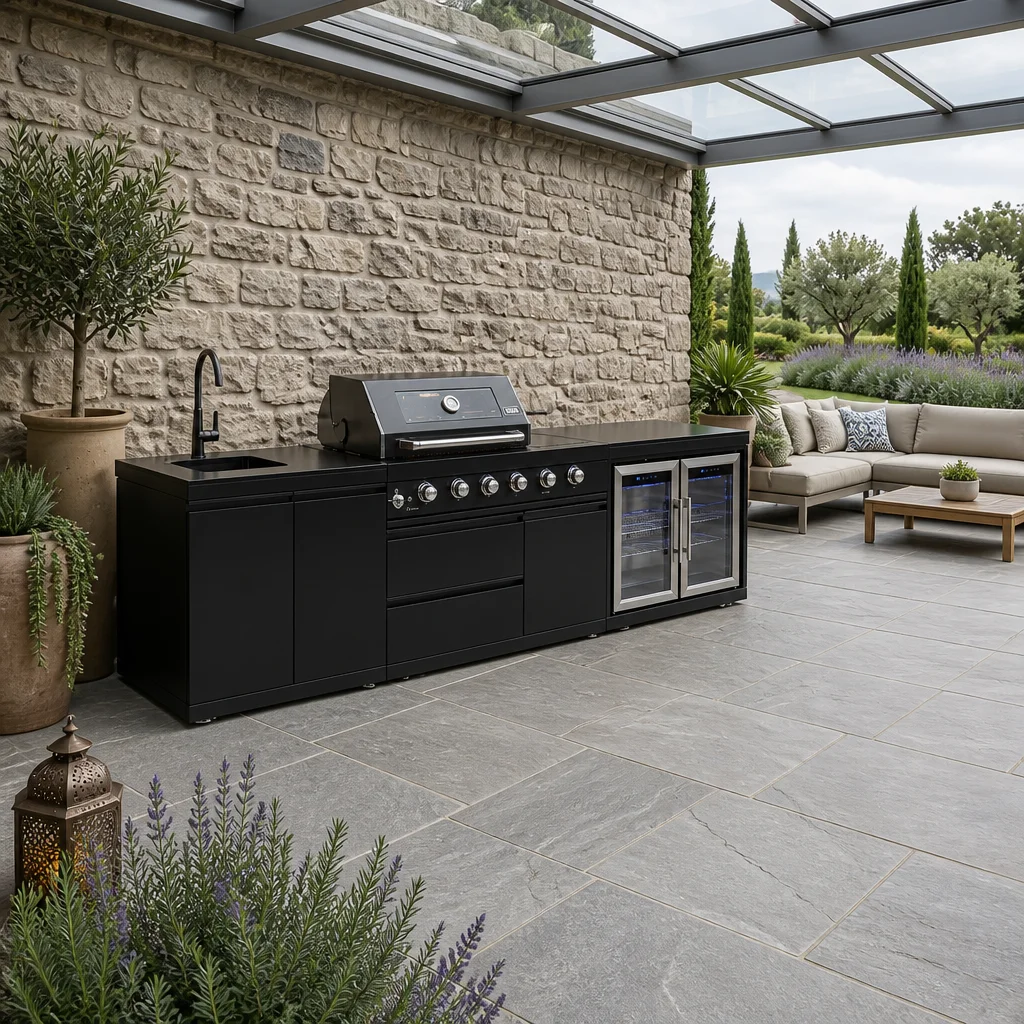
The matte black configuration in the same terrace setting — black cabinetry with a stainless grill hood, integrated sink and a double glass-door cooler
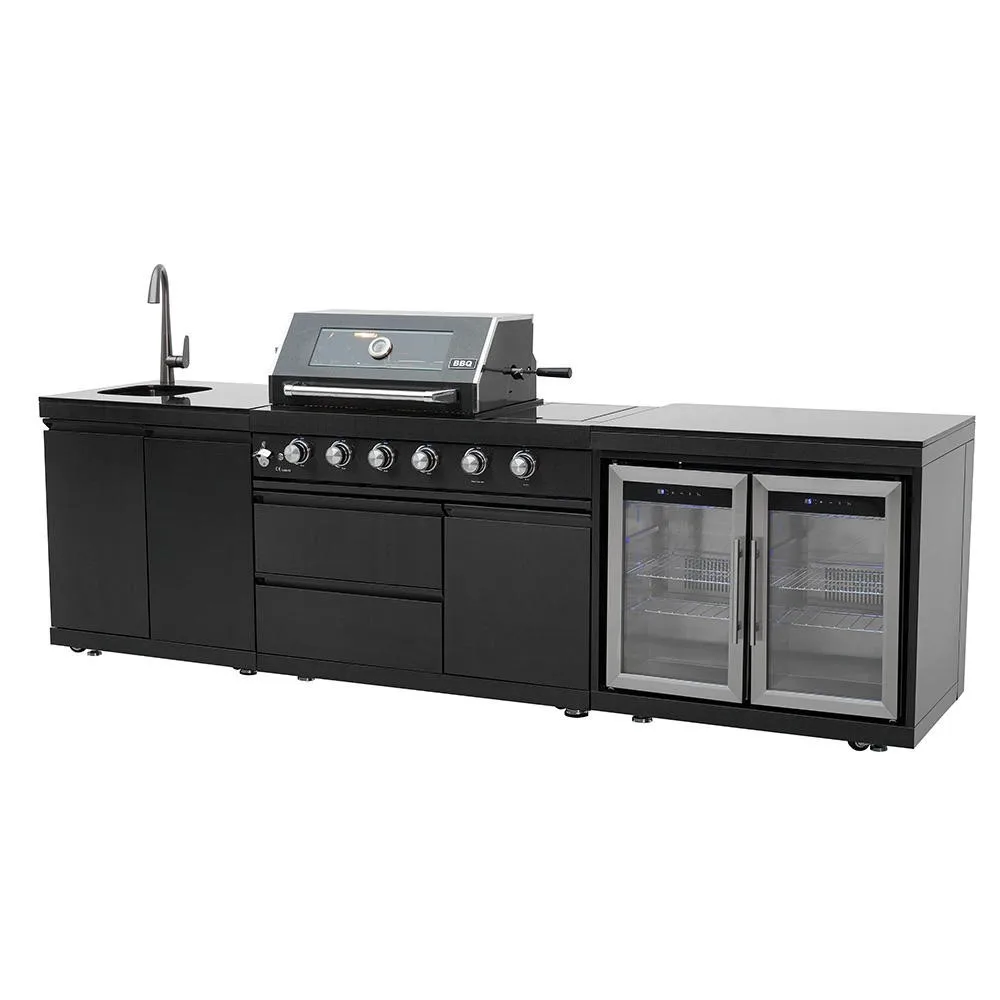
Black cabinet and counter, stainless grill hood with temperature gauge, a six-knob control panel, sink with high-arc faucet and a double glass-door cooler with interior lighting
For importers and distributors, the usual starting point is a short brief: the run length and module mix you want to sell, your target market and its gas type, the local voltage, and the finish and packaging you need.
Send that brief and we will come back with a configuration, a loading plan for your container and a quotation. Tell us at the same time whether your market is coastal — it changes the stainless specification and we would rather build it in than have you discover it later.