EN


LQ-B4R Built-In Gas Grill: Why the Cutout Comes First
A built-in grill is the last thing chosen and the first thing that goes wrong. By the time a homeowner picks one, the counter has been drawn, the gas line has been run and the masonry is going up. The grill does not get to define the space — it has to survive a space that was defined before anyone read its specification sheet.
That inverts the usual sales conversation. A freestanding grill is bought on the flame and the lid; a built-in grill is bought on the cutout, the clearance behind the hood and whether the grease tray can still come out. The LQ-B4R is a 68 kg stainless drop-in unit with a rotisserie and an infrared back burner, and it is worth reading the same way a fabricator would read it.
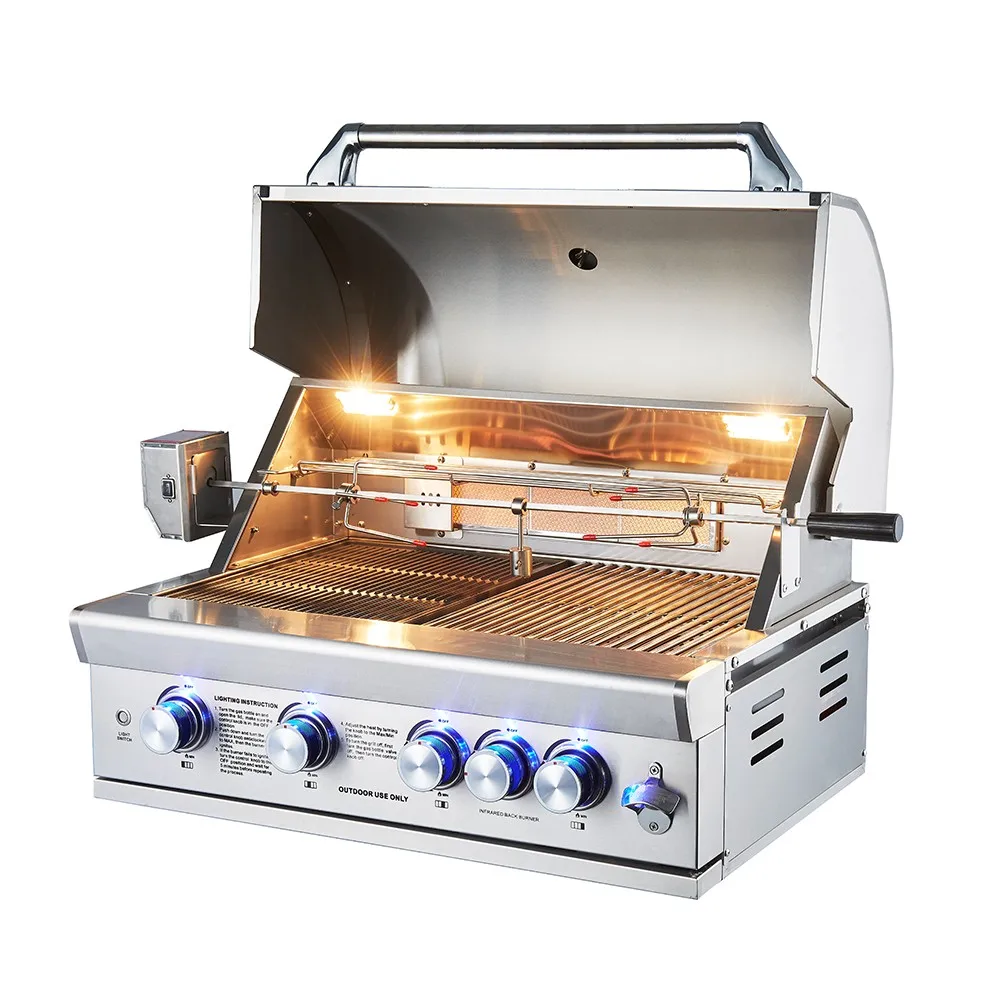
LQ-B4R: a drop-in stainless grill with rotisserie, infrared back burner and twin hood lights
The Cutout Is the Product
The B4R measures 870 × 627 × 533 mm overall. Those three numbers are not equally important, and only one of them is really a millwork number.
- 870 mm is the width that has to be accommodated, not the width you cut. A drop-in grill sits on a lip or flange at the top of the opening, so the cutout is smaller than the unit and larger than nothing: the fabricator needs the flange width and the depth of the body below the lip, not just the headline dimension.
- 627 mm of depth is where installations fail. The body has to drop into the counter, and behind it the hood needs room to open through its full arc with the rotisserie motor fitted on the left. A counter drawn tight to a wall will pass a drawing review and fail on site.
- 533 mm is the reason the counter has to be built for it rather than adapted to it. That is a deep cabinet, and it has to be ventilated. A grill enclosed in a sealed box overheats, and a gas appliance in an unventilated cavity is a safety problem before it is a performance one.
One detail on the sheet is worth a second look: the carton measures 860 × 650 × 590 mm, which is narrower than the unit's 870 mm overall width. A carton cannot be narrower than the object inside it, so something must come off for packing — almost certainly the rotisserie motor and its left-hand bracket, which is the part that protrudes. Confirm this with the factory before you publish a handling note, because it decides whether the unit arrives assembled or as a head plus a separate motor box, and that changes your installation schedule.
0.33 m² at 19.3 kW: What That Actually Means
The cooking area is 723 × 460 mm, which is 0.333 square metres. The rated output on our listing is four 3.7 kW tube burners plus a 4.5 kW rear infrared burner, which totals 19.3 kW — and 19.3 kW converts to 65,854 BTU, matching the 66,000 BTU on the specification. The figures reconcile, which is not always true of grill sheets.
Divide one by the other and you get the number that actually describes how the grill behaves: roughly 58 kW of rated input per square metre of cooking surface. That is a searing machine. It is why the grill will put a crust on a steak in the time a domestic oven takes to reach temperature, and it is also why it will burn sugar-based marinades if a buyer treats it like an oven.
The commercial consequence is a training problem rather than a product problem. A distributor selling into a project needs the counter staff to explain that this is a high-heat-density grill: sear on the main burners, finish on the infrared back burner with the rotisserie running, and use the lid for anything that needs time. Sold that way it justifies its price. Sold as "a big grill", it produces complaints from the first customer who walks away from it.
The Rotisserie Is a Retail Feature, and a Site Requirement
Two things separate a project grill from a countertop one, and neither is the cooking area: the rotisserie and the infrared back burner behind it. The back burner exists to brown a turning bird without a lid-down indirect setup, and the rotisserie is what a showroom can actually demonstrate — a turning spit with a bird on it stops people in a way a closed lid never will.
So it sells. But it also adds two requirements to the drawing that buyers routinely forget:
- A power socket at the counter. The motor in our listing is a 13 W unit rated 220–240 V, 50–60 Hz, mounted on the left-hand bracket. No socket, no rotisserie — and running an extension lead across a finished patio to a grill is exactly the kind of detail that turns a handover into a callback.
- Clearance on the left. The motor and its bracket project beyond the body. A grill set flush into a side wall has a rotisserie that cannot be fitted.
There is also a merchandising point worth passing to your dealers. A grill that is shown with the hood open sells the interior — the lights, the grates, the burner layout, the spit. A grill shown closed sells nothing but a lid. On a shop floor that single choice moves units.
68 kg, and What 216 Per Container Tells You
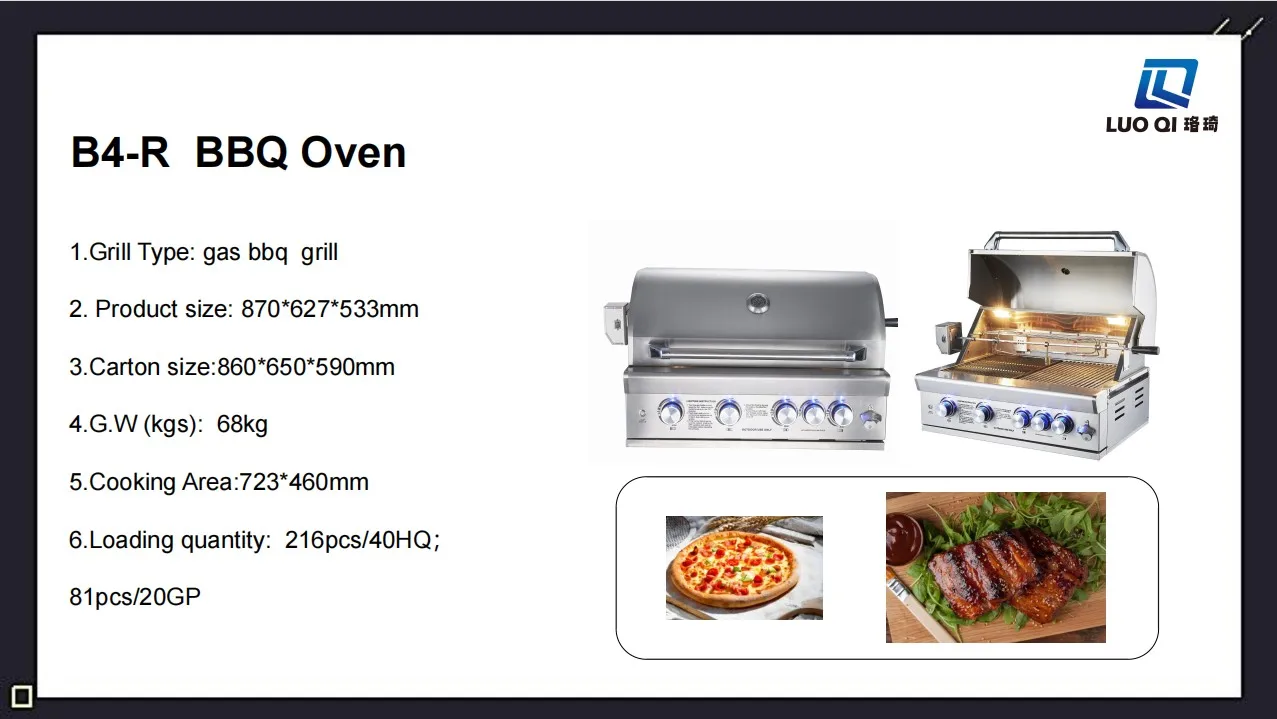
LQ-B4R specification: 870 × 627 × 533 mm, 723 × 460 mm cooking area, 68 kg gross, 216 pcs per 40’HQ
The gross weight is 68 kg per carton, and the carton is 860 × 650 × 590 mm — 0.330 cubic metres. Multiply it out against the loading figures on our sheet:
- 216 pcs per 40’HQ = 71.2 cubic metres
- 81 pcs per 20’GP = 26.7 cubic metres
Both land almost exactly on the usable volume of their container, which means this is a volume-bound product, not a weight-bound one: 216 cartons weigh 14.7 tonnes, a small fraction of what a 40-foot box will carry. The lever you have is therefore carton efficiency, not weight reduction — and for a stainless cabinet with a glass-free hood, the carton is mostly air and corner protection by design.
There is a second, less obvious consequence. At 68 kg, this is not a parcel product. It does not go through an e-commerce channel; it goes on a pallet to a dealer, a fabricator or a project site. Plan your freight and your warehouse around pallet handling, not around individual cartons.
What to Verify Before the Counter Goes In
This is the list to put in front of a fabricator, and it is the list that prevents the expensive version of a mistake.
- Cutout drawing, not overall dimensions. Ask for the flange width, the body depth below the lip, and the required clearance behind the hood through its full opening arc.
- Ventilation of the enclosure. Confirm what the cabinet needs — open front, louvres or vents — and put it on the drawing.
- Gas supply and connection type for the destination market, agreed before the counter is cut.
- Grease management. Confirm the tray or drawer can be removed with the unit installed. A tray that needs the grill lifted out is a design fault discovered at the first clean.
- Service access to the burner controls and the ignition from the front, without dismantling the counter.
- Whether the motor ships fitted or separate, and what that does to the installation sequence.
- Certification for the destination market, and the manual language that goes with it.
OEM and the Project Channel
The B4R is built in stainless steel 304, which is the grade that survives an outdoor counter in most markets and the one most fabricators ask about first. Because the unit is a drop-in head rather than a complete cart, customisation is concentrated in four places: the fascia and finish, the gas jetting and connection for the destination market, the retail or project carton, and the manual package.
What a factory needs in order to quote a programme is short: the market, the gas type and supply pressure, the annual volume, the finish, and whether the order is retail-pack or project-pack. Project-pack — plain cartons, no point-of-sale print, drop-ship ready — is increasingly what outdoor-kitchen contractors ask for, and it is cheaper than a retail box.
Professional Tips for Buyers
- Sell the cutout drawing, not the product photo. Fabricators buy drawings; homeowners buy photos. You need to give both.
- Ask for the hood's opening arc and the left-hand motor clearance as separate figures. They are the two dimensions that break installations.
- Price the pallet, not the carton. At 68 kg this is a pallet product from the first unit.
- Put the power socket for the rotisserie on the counter drawing at specification stage; retrofitting one into finished masonry is the expensive version.
- Confirm the grease tray can be removed with the grill installed, and film it. It is the question every installer asks.
- Train the counter staff on heat density. A 58 kW/m² grill sold as a general-purpose cooker will generate complaints that are actually user error.
- Order the motor bracket and spit as spares with the first container. They are the parts a project site loses.
FAQ
What is the LQ-B4R?
A built-in (drop-in) gas BBQ grill in stainless steel 304, measuring 870 × 627 × 533 mm with a 723 × 460 mm cooking area, a rotisserie and an infrared back burner. Gross weight is 68 kg per carton.
Is it freestanding or built-in?
Built-in. It is designed to drop into a counter or masonry opening, so the installation is defined by the cutout drawing and the clearance behind the hood rather than by a cart.
What is the total heat output?
Four 3.7 kW tube burners plus a 4.5 kW rear infrared burner, totalling 19.3 kW — quoted as 66,000 BTU. Measured against the 0.33 m² cooking area, that is a high-heat-density grill built for searing.
Does the rotisserie need a power supply?
Yes. The motor is a 13 W unit rated 220–240 V, 50–60 Hz and mounts on the left-hand bracket, so the counter needs a socket and the installation needs clearance on that side.
Can it be installed indoors?
No. It is marked for outdoor use only. Any covered outdoor kitchen is fine; an enclosed interior room is not.
How many fit in a container?
216 pieces per 40’HQ and 81 per 20’GP. At 0.330 m³ per carton that is 71.2 and 26.7 cubic metres — the load is limited by volume, since 216 cartons weigh only 14.7 tonnes.
Can it be produced under our own brand?
Yes. Finish and fascia, gas jetting and connection, carton artwork and manual language are all open to specification. Retail-pack and plain project-pack are both available.
Next Step
The B4R sits in our BBQ grill range and is the model we supply most often into outdoor kitchen projects, where the grill is one module in a run rather than a purchase on its own. If you supply fabricators, landscape contractors or hospitality terraces, send us the market, the gas type and supply pressure, the finish you want and the annual volume. We will come back with the cutout drawing, the clearance figures and a quotation.
If you are still choosing a format, our guide to flame patio heaters covers the other half of the terrace specification.