EN


Gas Flame Patio Heaters: A Sourcing Guide for Hospitality and Garden Retail
A patio heater is sold twice. The first time it is sold on the flame, because a visible fire on a terrace is the reason the customer stops walking. The second time it is sold on everything the flame costs — glass that survives the winter, a base that will not tip, a burner that relights on the third attempt, and a cylinder a member of staff can change in the middle of service without closing the terrace.
Both sales matter, and most sourcing mistakes happen because the first one is easy and the second one is not.
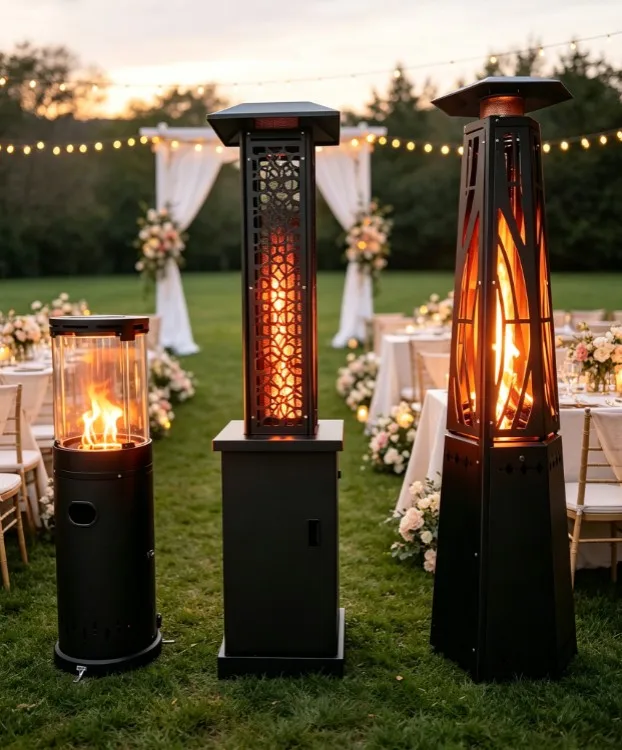
Three flame formats on one lawn: LQ-601 glass-tube cylinder, LQ-701 lattice tower, LQ-702 tapered pyramid tower
Three Form Factors, Three Buying Decisions
The shape is not decoration. Each of the three formats in the photograph above solves a different commercial problem, and the choice is usually made by the venue rather than by the catalogue. Left to right, they are the LQ-601, the LQ-701 and the LQ-702.
LQ-601 — the glass-tube cylinder
The shortest of the three: a cylindrical body with a glass sleeve and the flame running up the middle. Because it stands low, it throws heat at seated height rather than over the heads of standing guests. That makes it the right unit for a lounge corner, a low table group or an event where people are sitting rather than walking. It is also the easiest of the three to move and to store, and the cheapest of the three to glass.
LQ-701 — the lattice tower
The middle format, and the most decorative. The column carries a cut-out pattern that reads as a lantern when lit and as an object during the day, which is why it appears at weddings and hotel courtyards where the heater is part of the styling rather than an apology for the weather. The trade-off is that a decorated panel is harder to clean and harder to inspect: you need to be able to see the burner and the flame through or past the pattern during service checks.
LQ-702 — the tapered pyramid tower
The tallest, and the one that defines the format in most European cities — the silhouette in the second photograph is what a Parisian terrace looks like in November. The flared height lifts the flame above head height, so the radiant heat reaches a ring of people standing or sitting at bar tables, and the tall glass enclosure keeps the flame vertical in a breeze. It is the format that carries the highest perceived value and the highest freight cost per unit, because the carton is large and the glass is long.
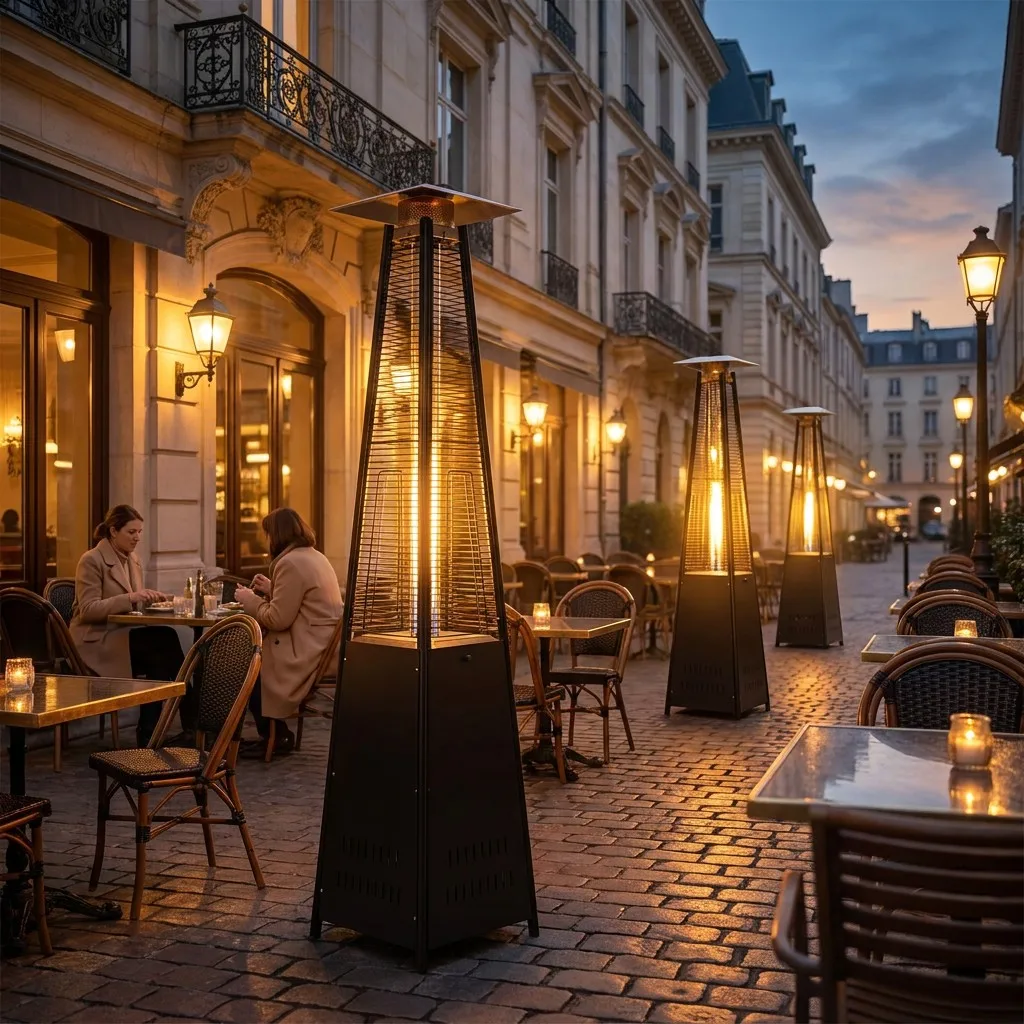
LQ-801 doing the job the pyramid format was designed for: holding a Parisian terrace open through the shoulder season
The street scene above is the same format at the scale a restaurant actually buys — the LQ-801. It stands 2,230 mm overall on a 530 × 530 mm base and is rated to a maximum of 46,000 BTU, which is the output class a venue needs to cover a pavement row rather than a single table group. Where the LQ-702 is drawn to be moved between a lounge and a lawn, the LQ-801 is drawn to stay put for a season.
How a Flame Patio Heater Actually Heats
It heats by radiation, not by warming the air. The flame warms the burner and the surrounding structure, and that heat travels in straight lines until it lands on a person, a chair or a wall. Two practical consequences follow, and both are routinely misrepresented in catalogue copy.
The first is that output falls off with distance. A guest sitting close is warm; a guest two tables away is not. This is why venues buy by seating plan rather than by total output: the unit is sized to a zone, not to a terrace.
The second is that wind is the real enemy. A visible flame in a breeze loses heat sideways before it reaches anyone, and it becomes a safety question rather than a comfort one. The glass enclosure on all three formats is there for exactly that reason — it is a wind guard, not a decorative sleeve.
The Four Components That Decide Quality
The glass
On a flame patio heater the glass is the single largest source of claims, and it is not ordinary glass. It has to take a flame at close range on one side and cold air on the other, for hours, and then survive a gust of rain. Ask the factory which glass is specified, how the edges are finished, and how the tube or panel is mounted — a long tube supported only at the base behaves very differently from one held at both ends.
The commercial question is not only breakage. It is whether you can supply a replacement. A venue with a broken glass tube in the middle of December needs a part, not a new heater. If the glass is not available as a service part, the unit is a consumable, and your buyer will treat it that way at renewal.
The burner and the flame pattern
What the customer sees is a flame, so the flame pattern is a specification. A burner that produces a narrow column reads as a candle; a wide, even sheet of flame reads as a fireplace. Ask for photographs of the unit running at night, not in a studio, and ask how the flame behaves at the low setting — some burners lose the pattern entirely when turned down.
Ignition is the second half of this. On a hospitality site the unit is lit and relit several times a day, often by staff who are not the person who bought it. Confirm the ignition method and ask what happens when it fails.
The base and the cylinder
The base is where the gas lives. In the pyramid and cylinder formats the cylinder is housed inside the body, which is why those units look as though they have no fuel supply at all. That is good design and it creates a service routine: staff have to open the base to change a cylinder, in the dark, in a hurry.
Ask how the base opens, whether the door or hatch can be operated with gloves on, and whether the cylinder compartment is vented. Then ask the question most catalogues will not answer: how long a cylinder lasts at the setting the venue will actually use.
Stability
A patio heater is tall, narrow and light, standing on a terrace where people lean, children run and the wind gusts. Tipping is the safety issue that matters most in this category, and it is solved by mass low down and by geometry — a wide base, a weighted plinth or a ballast compartment.
Confirm what the base weighs empty, whether ballast is required on site, and whether the unit can be anchored. For a hospitality buyer, a heater that must be brought inside every night because it might blow over is not a heater, it is a chore.
Weather, Storage and the Shoulder Season
This category lives outdoors for months, so the finish has to survive more than a showroom. Powder coating over steel is the norm; the failure mode is at the fasteners, the welds and the base, where water sits. Ask about the coating, the fastener material and whether the unit is designed to be stored assembled or broken down.
Coastal sites are the hardest case and worth a separate conversation at quotation stage. Salt air attacks exactly the places a coat of paint is thinnest. If your market includes seaside hospitality, say so before the order rather than after the first season.
Rain is the second issue, and it is mostly about the burner rather than the body. A unit that collects water in the burner will not light until it is dried out. Ask how the burner is shielded when the unit is not running.
What Hospitality Buyers Ask That Retail Buyers Do Not
Garden retail buys on appearance and price. Hospitality buys on uptime, and the questions are different in kind.
- Duty cycle. A domestic unit runs for an evening. A terrace unit runs for six hours a day, five days a week, for five months. Ask what the burner and the glass are rated for, not just what they can do once.
- Refuel downtime. If changing a cylinder takes two people and ten minutes, the venue loses seating. Ask how long a change takes and whether it can be done with customers present.
- Spares availability. Glass, burner, ignition, regulator, base hatch. A venue will pay for a part; it will not pay for a replacement unit because a part does not exist.
- Consistency of flame. A row of eight heaters on a terrace should look like a row, not like eight different flames. Ask about batch consistency if the order is large.
- Storage. Where does it live in July? A tall pyramid is awkward to store; a cylinder format is not. That single question can decide the order.
Compliance and Documentation
Outdoor gas appliances are certified against their own standards, separately from indoor room heaters, and a certificate for one does not cover the other. Do not assume that a supplier who can document an indoor radiant heater can document a patio heater.
Before you commit a container, ask for the certification documents for the specific model and the market you are selling into, and confirm the labelling and manual language requirements that come with them. Hospitality sites are inspected more often than gardens, and a venue that cannot show documentation will stop using the heaters rather than risk it.
What to Confirm Before Ordering
- The gas the unit is jetted for, and the cylinder connection for the destination market
- Glass type, mounting method and whether glass is available as a service part
- Base weight empty, ballast requirement and anchoring option
- Ignition method, and the relight procedure in the manual
- Carton dimensions and units per container, for each of the three formats
- Certification documents for the model and the market
- Spares list and the first-stock spares order
Professional Tips for Buyers
- Buy the glass before you buy the heater. If the glass is not a service part, the product has a one-season life.
- Ask for night photographs of the flame, not studio shots. The flame is the product.
- Weigh the base empty, and decide whether ballast has to be added on site. A tall unit that needs ballast is a delivery problem you should price in.
- Ask how long a cylinder lasts at the setting the venue will use, not at the setting in the brochure.
- For hospitality orders, buy one sample and run it for a week before you commit the container.
- Confirm the cylinder connection per market. A heater that arrives without the right regulator is a return, not a sale.
- Stock glass and ignition as spares. They are the two parts that take a unit out of service.
FAQ
What is a flame patio heater?
A freestanding outdoor heater in which the flame is visible through a glass enclosure. The glass acts as a wind guard and as the visual centre of the product. It heats by radiation, in a ring around the unit, rather than by warming the surrounding air.
Do they run on propane or natural gas?
It depends on the build. Cylinder formats are designed around a propane or butane bottle housed in the base; piped formats run from a fixed supply. Confirm which gas the unit is jetted for and which cylinder connection the destination market uses — this is a factory specification, not a field adjustment.
How far does the heat reach?
Radiant output falls off with distance, so there is no single radius figure worth quoting. Size the unit to a seating zone rather than to a whole terrace, and ask the factory for the throw at each setting rather than accepting a radius claim in a brochure.
What happens if the glass breaks?
Provided the glass is available as a service part, the unit is repaired. If it is not, the heater is effectively a consumable. Ask this question before ordering — it decides the product's service life and your after-sales cost.
Can it be left outside all season?
That is what it is designed for, but the failure points are the fasteners, the welds at the base and the burner, where water collects. Ask about the coating, the fastener material and how the burner is shielded when the unit is not running. Coastal sites need a separate conversation.
Which format suits a café and which suits a garden?
Cafés generally want the tall pyramid format, because it lifts heat above seated head height and holds a terrace through the shoulder season. Domestic gardens and lounge settings usually want the lower cylinder or lattice formats, which put heat at seated height and are easier to store.
What certification applies?
Outdoor gas appliances are certified against their own standards, separately from indoor room heaters. Ask for the documents for the specific model and market, and note that a certificate for an indoor heater does not transfer.
Can they be produced under our own brand?
Yes. Finish, glass configuration, packaging and manual language are all open to specification. Bring the destination market, the format mix, the volume and the channel you sell through.
Next Step
We build patio heaters in the pyramid format alongside the rest of our outdoor heating range, and the models in these photographs — LQ-601, LQ-701 and LQ-702 for a mixed terrace, or the larger LQ-801 for a street frontage — are the ones most often specified together by hospitality buyers. If you are fitting out terraces, supplying event rental or stocking garden retail, send us the format mix you want, the destination market and its gas and cylinder standard, and your annual volume. We will come back with the specification, the spares list and a loading plan for each format.
If your buyers also need portable heating for indoor rooms, our guide to infrared versus blue flame covers that side of the range.