EN


LQ-H006 Natural Gas Warm Air Heater: Reading the Specification Before You Order
The LQ-H006 is a different kind of product from the portable radiant heaters most of our distributors carry. It is a fixed warm-air cabinet, built for natural gas, controlled from a touch panel, and fitted with a thermostat. That changes who buys it, how it is installed, and which markets it can legally enter.
What follows is the specification sheet read commercially rather than literally — what each number means once you stop quoting it and start selling it.
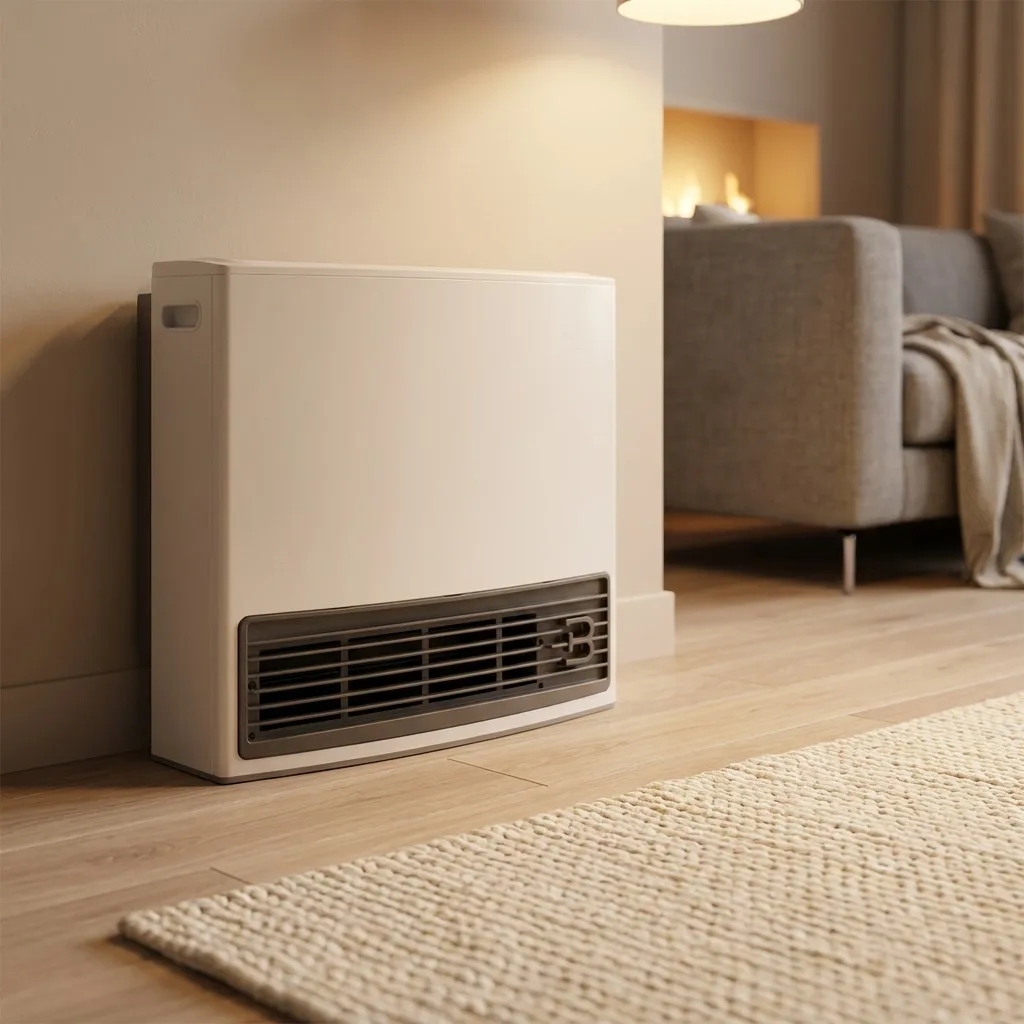
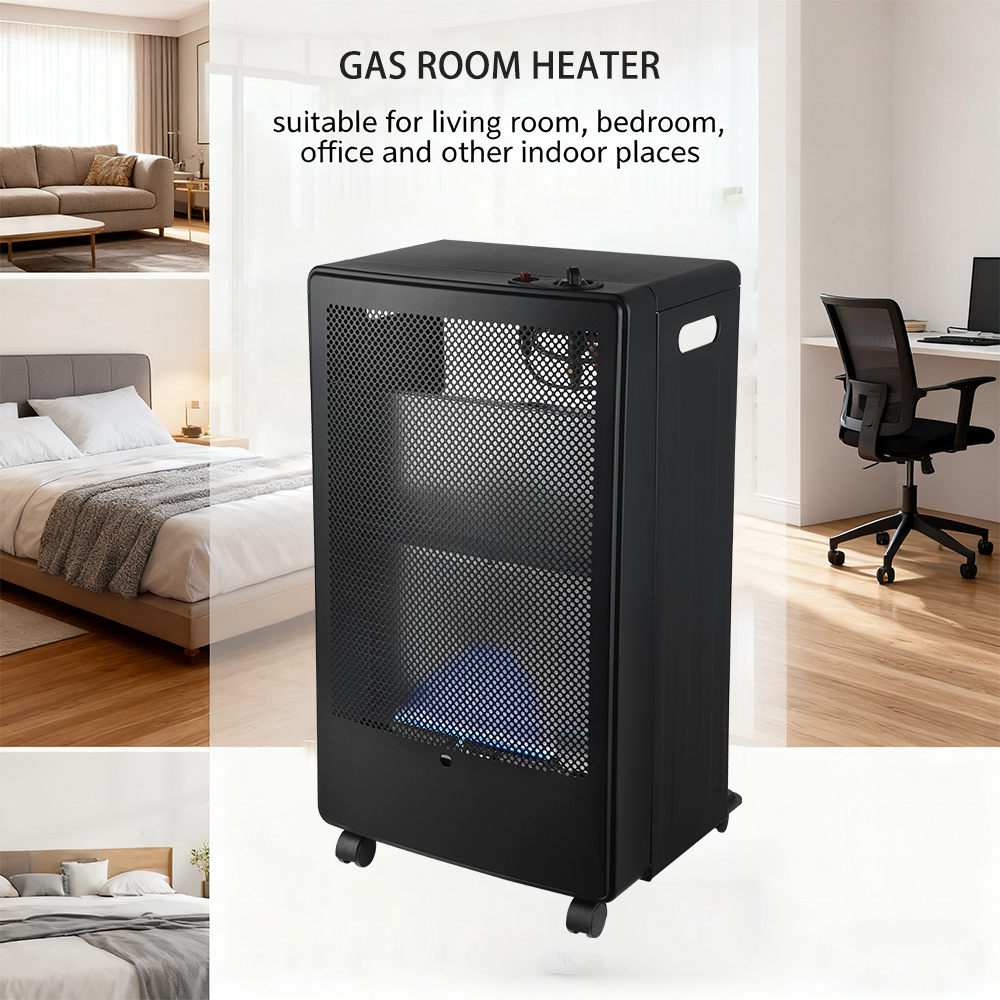
LQ-H006: a floor-standing warm-air cabinet with a low level grille, sized to sit under a window or against a wall
What the H006 Is, and What It Is Not
Three things define this unit, and all three come straight off the sheet.
- Warm air heating. The heat leaves through the grille at the bottom of the cabinet and circulates by air movement. It is not a radiant panel and it does not glow. A warm-air heater heats the air in the room; a radiant heater heats the objects and people it faces.
- Natural gas, 2,000 Pa. Not LPG, and not dual fuel. The burner is set for mains gas at a 2,000 Pa supply pressure, which is 20 mbar.
- 220 V / 50 Hz. The unit needs mains power. A warm-air cabinet moves heat with a fan, and the fan plus the touchscreen board is what that supply is for. This is not a power-free appliance.
Those three lines already exclude a large part of the world. Any market running 120 V at 60 Hz is out without a different electrical build. Any market where the domestic heating gas is LPG in cylinders is out without a different burner. What is left is the natural-gas, 220–240 V world: most of Europe and the UK, and a long list of markets across Asia and the Middle East.
The Heating Numbers
1.6 to 4.2 kW, quoted as 5,500 to 14,500 BTU
The sheet gives a range rather than a single output, which usually means the burner has more than one setting rather than a continuously variable valve. Both figures convert cleanly: 1.6 kW is about 5,460 BTU and 4.2 kW about 14,330 BTU, so the round numbers on the sheet are conversions, not separate measurements.
Practically, 4.2 kW is the top of the domestic portable class. It is enough for a living room in a well-insulated European apartment and not enough for an open-plan space with a stairwell. Do not let a retail listing promise a square-metre figure you have not tested — output in kW and the room it suits are two different claims.
2,000 Pa is a specification, not a formality
2,000 Pa is 20 mbar. A burner jetted for 20 mbar will not run correctly on a network delivering something else, and the fix is a jet change, not a regulator tweak on site. Before you commit a container to a market, confirm the nominal supply pressure your customer's network actually delivers and ask the factory to jet to it. This is the single most common reason a natural-gas heater arrives in a market it cannot be commissioned in.
Where the sheet is silent
There is no certification mark, no efficiency figure, no gas consumption rate and no unit weight on this sheet. That is not unusual for an internal specification, but it means the approval route is a question you have to ask rather than read. Ask which approvals the unit carries for your destination market, and get the test report that goes with them, before you print a box.
Warm Air Feels Different, and Sells Differently
A radiant heater is felt within a minute because it shines heat onto you. A warm-air heater has to move a room's air before the room changes, so the first ten minutes feel slower, and then the room stays even. This is the difference that decides whether a customer is happy, and it is worth training your counter staff on.
Two consequences follow. First, a warm-air unit is the better choice for anyone who uses a room for hours rather than minutes — a living room, a small office, a shop counter. Second, it is the worse choice for someone who wants to sit in front of the heat and be warmed immediately, which is what our portable radiant models are for. Presenting these as alternatives rather than as a range solves most of the returns conversation before it happens.
The Controls Are Half the Product
Touchscreen, constant temperature, timer
The sheet lists a touchscreen panel, a constant temperature control system with free adjustment of time and temperature, and a timing function. Read together, those three lines describe a thermostat: you set a target temperature, the unit modulates to hold it, and you can schedule when it runs. That is a materially different product from a heater with a knob marked low and high.
For a buyer, the thermostat is what turns the unit from a heating appliance into a comfort appliance. For a distributor, it is what allows a higher price point and what justifies stocking it next to fixed electric panel heaters rather than next to cheap portable gas units.
Child lock
A touch panel is easy to change by accident with a hand, a sleeve or a pet. The child lock is not a marketing line on a product like this; it is the reason the thermostat setting survives contact with a household. Make sure your manual explains how to engage it in the destination language, because a lock nobody can work is worse than no lock.
Four Safety Devices, and What Each One Does
The sheet lists ODS, anti-tilt and flameout protection, plus the child lock above. They do different jobs, and buyers should understand the difference.
- ODS — oxygen depletion sensor. Shuts the unit down when the oxygen level in the room falls. This is the device that makes an unflued gas appliance usable indoors, and it is the one to emphasise in any market with tight, well-sealed housing stock.
- Flameout protection. Cuts the gas if the flame goes out, so the burner cannot discharge unburnt gas into the room.
- Anti-tilt. Cuts the unit if it is knocked out of position. On a floor-standing cabinet with a low grille, this is a household safety device rather than an industrial one.
- Child lock. Prevents the settings being changed by accident, not a combustion safety device.
None of these replaces ventilation. An unflued gas appliance needs air, and the manual should say so plainly. ODS is a backstop for the day the room runs short of oxygen, not a licence to run the heater in a sealed room with the door shut. Say that in writing in every language you print.
Dimensions, Packing and What 820 Units Actually Means
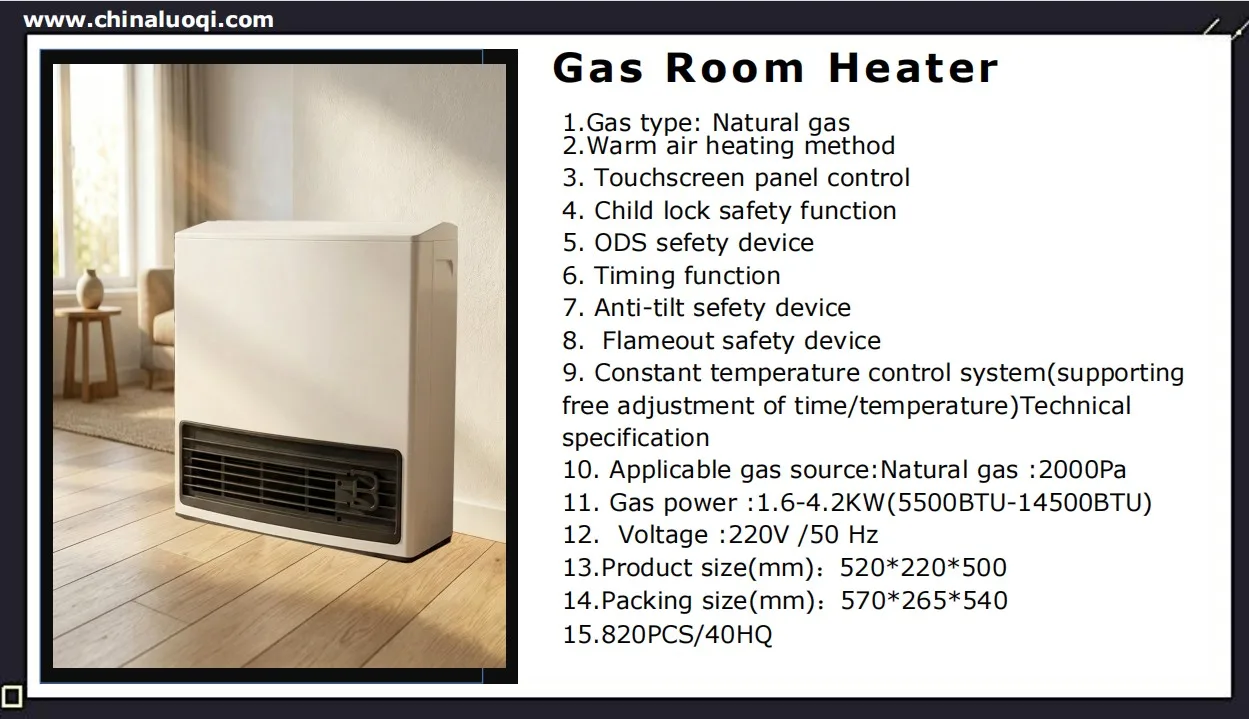
The LQ-H006 specification: natural gas at 2,000 Pa, 1.6–4.2 kW, 220 V / 50 Hz, 520 × 220 × 500 mm, 820 pcs per 40’HQ
520 × 220 × 500 mm
The 220 mm figure is the depth, and it is the one that sells the unit. A gas cabinet 220 mm deep fits under a window, into a hallway, or beside a door without eating floor space, which is the constraint in most European apartments. The 520 × 500 mm elevation is roughly square, so the cabinet reads as a low, wide block rather than a tower.
Confirm the axis order on the drawing before you publish a dimension diagram. The packing figure supports the reading — 570 × 265 × 540 mm is the same order with padding added — but it costs nothing to have the factory confirm it in writing.
The carton, and the 30% that is air
The packing carton measures 570 × 265 × 540 mm, which is 0.0816 cubic metres. The product itself occupies 0.0572 cubic metres. The difference is about 30% — the cushioning, the base and the clearance around the cabinet.
Thirty per cent is normal and it is not waste; it is what protects a steel cabinet with a control board in transit. What matters is that the carton has been drop-tested and that the board and the grille are separately protected inside it. Ask for the drop test report rather than a verbal assurance.
820 per 40’HQ, and why that is a volume figure
820 cartons at 0.0816 cubic metres each is 66.9 cubic metres, which is very close to the usable volume of a 40’HQ once you allow for dunnage and stacking. So the loading figure is set by cubic volume, not by payload. That is useful: it means the freight maths is stable and predictable, and it means the lever you have is carton efficiency rather than weight reduction.
Check the gross weight against the container payload before you plan the last pallet, and remember that 820 is a full container, not a minimum order. MOQ is a separate negotiation.
Which Markets This Unit Fits
Where it fits
Natural gas at 2,000 Pa with a 220–240 V supply is the profile of most of continental Europe, the UK, and a range of markets across Asia and the Middle East. Markets with a fixed natural-gas grid, apartment living and a cold season are the natural home for a thermostat-controlled warm-air cabinet.
Where it does not
Three exclusions worth stating plainly, because they cost money to discover late:
- 120 V / 60 Hz markets. The United States, Canada, Japan and much of Latin America need a different electrical build.
- LPG markets. Cylinder-gas markets need a different burner and jetting. This is not a field conversion.
- Markets with a different nominal gas pressure. Confirm the network pressure and re-jet before the order, not after arrival.
OEM and What to Bring to the Factory
This is a straightforward unit to customise, because most of the variables are cosmetic or territorial rather than structural. The list that actually moves a programme forward:
- Cabinet finish and colour
- Touch panel and manual language for the destination market
- Plug type, cord length and voltage confirmation
- Gas jetting for the market’s nominal supply pressure
- Retail carton artwork, barcode and language
- Annual volume and target price band
Bring those six and a factory can quote a real programme. Bring a request to change the burner and you have a development project instead.
Professional Tips for Buyers
- Confirm the destination market’s nominal gas pressure first. It decides the jetting, and jetting decides whether the container is usable.
- Ask for the approval documents and the test report before you print packaging. The sheet carries no certification mark, so this is an open question, not a formality.
- Specify the plug and cord for the market. A 220 V unit with the wrong plug is a return, not a sale.
- Get the drop test report for the carton, and check how the control board is protected.
- Test the thermostat’s hysteresis. A thermostat that swings several degrees is a comfort complaint waiting to happen.
- Stock the wear parts with the first container: control board, fan, ODS probe, ignition.
- Sell it as fixed comfort heating, not as a portable heater. The positioning changes the price it can carry.
FAQ
What is the LQ-H006?
It is a floor-standing gas room heater that distributes heat by warm air. The cabinet houses a natural gas burner, a fan, a touchscreen control panel and a thermostat. It is a fixed comfort appliance rather than a portable radiant heater.
What gas does the LQ-H006 run on?
Natural gas, set for a supply pressure of 2,000 Pa, which is 20 mbar. It is built for mains gas, not for a cylinder.
Can it run on LPG?
Not as supplied. LPG requires a different burner and different jetting, and that is a factory build rather than a field conversion. If you need a cylinder-gas version, raise it at the enquiry stage.
What is the heat output?
The range is 1.6 kW to 4.2 kW, quoted on the specification sheet as 5,500 BTU to 14,500 BTU. The BTU pair is a conversion of the kW figures, rounded.
Does it need electricity?
Yes. The unit is rated 220 V / 50 Hz, which runs the fan and the touchscreen control board. This is not a power-free appliance, and it is one of the differences between this unit and our portable radiant models.
What size is it?
The product measures 520 × 220 × 500 mm, with 220 mm as the depth, and it packs into a 570 × 265 × 540 mm carton.
How many fit in a 40-foot container?
The specification sheet gives 820 pieces per 40’HQ. At 0.0816 cubic metres per carton that is about 66.9 cubic metres, so the load is limited by volume rather than by payload. Confirm the gross weight against the container payload before you finalise the plan.
What safety devices are fitted?
An oxygen depletion sensor, flameout protection, an anti-tilt switch and a child lock. The first three are combustion safety devices; the child lock protects the settings. None of them replaces ventilation, and the manual should say so.
Can we order it under our own brand?
Yes. Cabinet finish, panel and manual language, plug type, gas jetting and retail carton are all open to specification. Bring the destination market, the volume and the target price band to the enquiry.
Next Step
The LQ-H006 sits in our gas room heater range alongside the portable radiant and blue flame models, but it sells to a different buyer: fixed installation, mains gas, thermostat control. If that is the segment you are trying to fill, send us the destination market, the nominal gas pressure your customers actually receive, the annual volume and the finish you want. We will come back with the approval documents, the jetting confirmation and a quotation.
If you are still weighing a radiator against a convector for your market, our guide to infrared versus blue flame covers the two radiant options and where each one wins.